Annuities: the product we don’t model
Every episode in this series has quoted a number from a projection. This one cannot, because the projection does not model annuities — and an episode that invented figures for a product the engine does not simulate would be worse than one that says so.
What an annuity does
You hand an insurer a lump sum and receive a guaranteed income for life. The insurer takes on the risk that you live a very long time, pooled across many people — which is something no individual portfolio can do for itself.
That pooling is the product’s genuine economic value, and it is why an annuity can pay more than a portfolio could safely withdraw. The people who die early subsidise the people who live long, which sounds grim and is exactly the insurance you are buying.
The real costs
- Irreversibility. The capital is gone. No emergency access, no change of mind, and nothing left for an estate beyond any guarantee period purchased.
- Inflation. A level annuity loses purchasing power every year, for the reasons episode 38 covered. Indexed annuities exist and pay materially less at the start.
- Interest rate sensitivity. The payout depends heavily on rates at purchase, which makes the timing of the purchase consequential in a way that feels arbitrary.
- Cost. The insurer’s margin and expenses are inside the payout rather than disclosed as a fee, which makes comparison harder than it should be.
Why the projection does not include one
Modelling an annuity honestly requires a payout rate, which depends on the insurer, the purchase date, prevailing interest rates, your health and the options selected. A projection cannot know any of those, and inventing a payout rate would produce a figure that looks authoritative and is not.
The tax treatment of a non-registered annuity — the split between the return of capital and the taxable interest portion — depends on the same variables. This is a documented gap rather than an oversight, and it is stated here rather than approximated.
The annuity you already have
Dan & Marie — 58 and 56, Alberta. Dan retires at 62 with a defined-benefit pension; Marie retires at 60. Their RRSPs are very different sizes, which matters later.
Deferring CPP is an annuity purchase in everything but name: you forgo income now to receive a larger, indexed, guaranteed, lifelong income later. There is no commission, no insurer credit risk, and the pricing is set in legislation.
Dan and Marie deferring to 70 raises lifetime CPP from $995,049 to $1,156,066 — a permanent 42.0% increase, with OAS deferral adding 36.0% on the same terms.
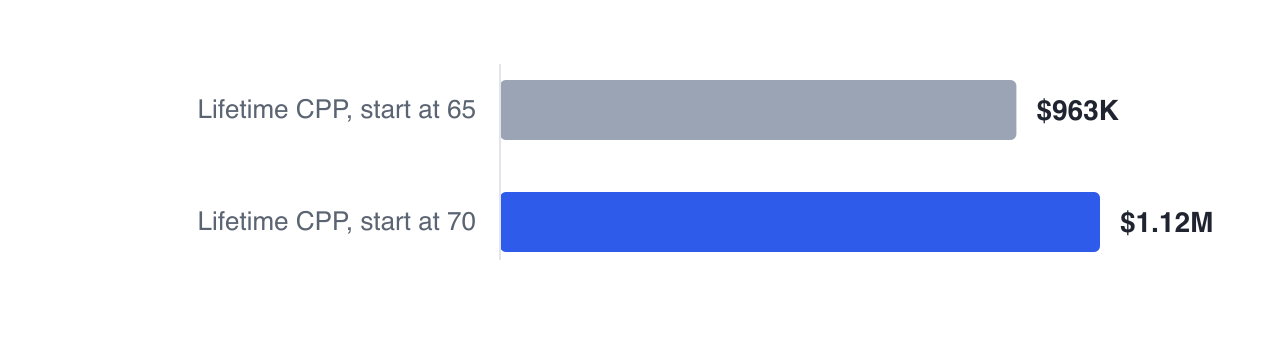
Which suggests an order of operations: exhaust the CPP and OAS deferral first, since the terms are better than anything commercially available, and consider a purchased annuity only for longevity risk that remains after that.
What to do with this
If you are considering an annuity, get actual quotes for the specific structure and date, and compare the guaranteed income against what your projection says the same capital would support. The projection can price the second half of that comparison precisely; the insurer prices the first.
Naming a limitation is more useful than papering over it. A tool that quietly approximated this would be giving you a number you could not check, about a decision that cannot be reversed.
The CPP/OAS optimizer scores every start-age pair against your plan — the cheapest longevity insurance available, and the one this projection can measure exactly.
Next: the same plan, scored two different ways.
GlidePathEngine is an educational planning tool — not financial, investment, tax, or legal advice.