Applying for CPP and OAS
Every episode about benefit timing assumes the benefit starts when you decided it would. That requires an application, months in advance — and for OAS it can require the opposite, because you may be enrolled automatically whether you wanted it or not.
CPP: always an application
CPP never starts on its own. It can begin as early as 60 and as late as 70, and in every case you apply — online or on paper — and the application should go in several months before you want payments to start.
A late application does not recover unlimited back payments; retroactivity is capped. Someone who intended to start at 65 and applied at 66 loses part of a year permanently, which is a poor return on a piece of forgotten paperwork.
Not everyone is auto-enrolled, and the letter is the only reliable signal about which group you are in. Anyone who receives no letter should apply, and anyone who does receive one and intends to defer should act on it rather than file it.
What deferring is worth
Deferring CPP to 70 increases it permanently by 42.0%; deferring OAS to 70 adds 36.0% to a benefit of around $8,999. Those are the increases episode 14 weighed, and they are only available to someone whose paperwork reflected the decision.
The GIS is separate again. It is income-tested annually, so it depends on filing a tax return every year even at an income low enough that no tax is owed. A retiree who stops filing because they owe nothing can lose the benefit entirely — the single most costly administrative mistake available in Canadian retirement.
What the paperwork controls
Priya — 54, Ontario, single. $118,000 salary, $410,000 in her RRSP and $88,000 in her TFSA, planning to retire at 63.
Priya’s CPP is $18,092 a year starting at 65 and would be 42.0% higher starting at 70. Her OAS is around $8,999 and would be 36.0% higher deferred.
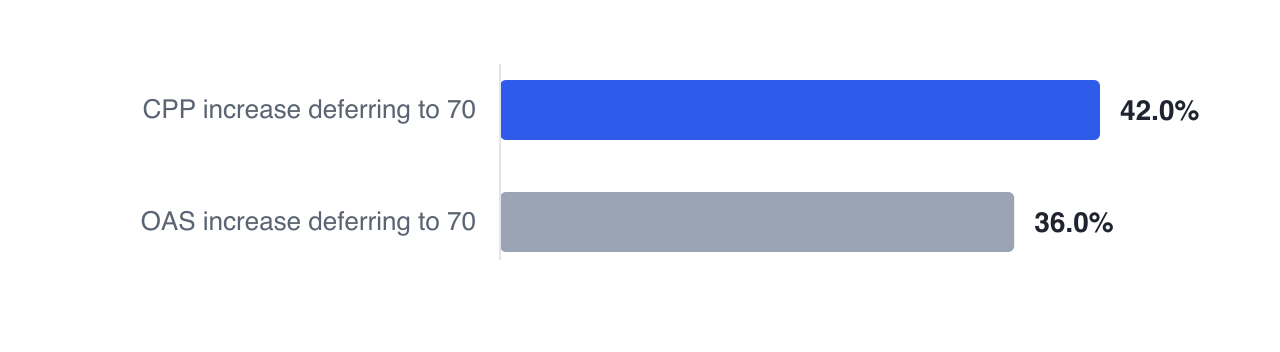
Both of those increases are decided by a form. Every projection in this series that compares start ages assumes the form matched the intention, which is the one part of the decision a plan cannot do for you.
A short checklist
- Set up a My Service Canada Account now, not at retirement — it holds your CPP contribution record, which is the input every projection needs.
- Apply for CPP several months before your intended start date.
- Watch for the OAS letter around 64, and respond to it if the plan defers.
- If you are approaching GIS eligibility, file a return every year regardless of whether tax is owed.
One more mechanic worth knowing: CPP can be shared between spouses who are both at least 60 and both receiving it. Sharing splits the portion earned during the relationship across the two returns, which is a separate application from the pension splitting in episode 28 and can help a couple whose CPP entitlements are very different. It is applied for, not automatic.
With your actual CPP estimate and start ages entered, the projection shows what each start age produces — the decision the paperwork then has to carry out.
Next: helping adult children without wrecking your own plan.
GlidePathEngine is an educational planning tool — not financial, investment, tax, or legal advice.