Asking "what if" properly
Every episode in this series has quoted a comparison, and every one of them changed exactly one thing. That discipline is not fussiness — it is the difference between a result you can act on and a number you cannot interpret.
The rule
This matters more than it seems because interacting levers are the norm rather than the exception in a retirement plan. Deferring CPP changes withdrawals, which changes balances, which changes mandatory minimums, which changes clawbacks. A scenario that also moved the retirement age has mixed two chains of consequence together.
What to hold constant
The subtle one is spending. If you compare two strategies and one of them also spends less, the comparison is meaningless — of course the plan with less spending ends with more. Every comparison in this series held the spending target fixed, which is what makes the differences readable as "same lifestyle, different outcome".
The same applies to the horizon. Comparing a strategy over a plan to 90 against one over a plan to 100 mixes a strategy question with a longevity question. The longevity question is worth asking; it is worth asking separately.
Reading the size of a difference
A one-variable comparison also tells you something a single plan cannot: how sensitive the outcome is to that variable. A lever that moves the answer a lot deserves attention; one that barely moves it can be settled on other grounds — convenience, comfort, simplicity — with no financial cost.
That is often the most valuable output. Discovering that a decision you were agonising over is worth very little is a real result.
Three separate questions, three separate answers
Priya — 54, Ontario, single. $118,000 salary, $410,000 in her RRSP and $88,000 in her TFSA, planning to retire at 63.
Priya’s baseline plan ends at $399,597. Changing the drawdown order alone gives $547,069. Retiring three years earlier alone gives $37,505. Planning to 100 alone gives $294,564.
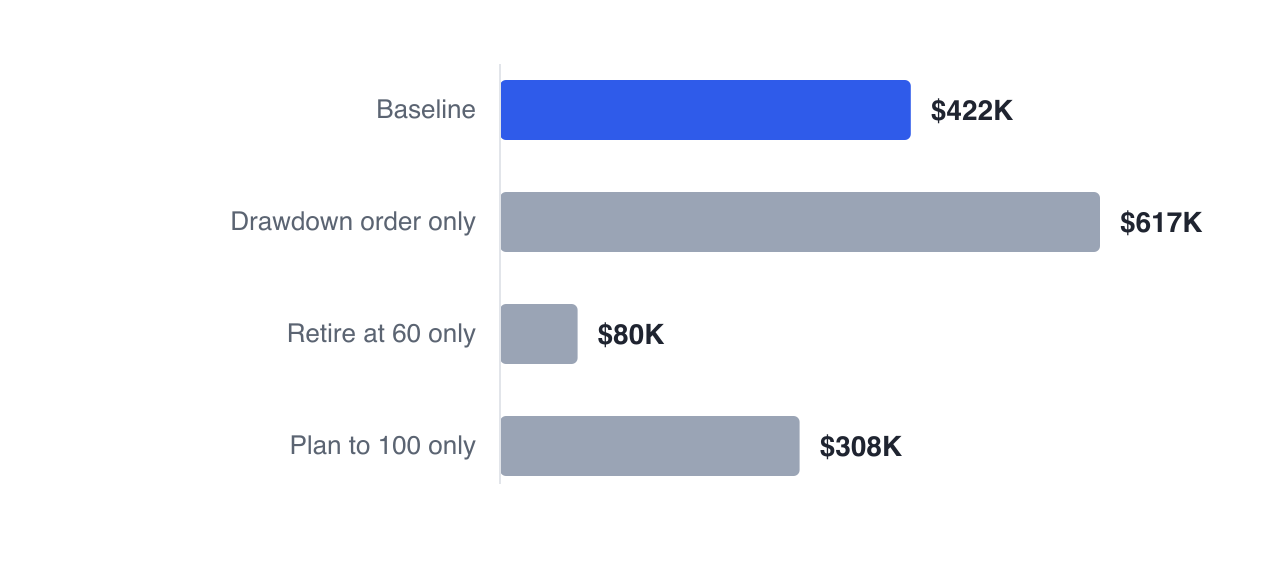
Three clean answers, each attributable. Had one scenario changed the order and the retirement age, the result would have sat somewhere in between with no way to know how much of the move came from which — and the temptation would have been to credit whichever change you preferred.
When to combine deliberately
There is one legitimate reason to move several levers together: measuring the combined effect, knowing that interacting levers do not simply add. The total of applying everything at once is a genuine question, and it is a different question from what each lever is worth.
The rule is to do both, and to label them differently. One-variable comparisons tell you what to prioritise; the combined scenario tells you where the plan lands if you act on all of it.
The compare tools let you define named scenarios that override specific inputs and overlay them on every chart — so a comparison is a controlled change rather than a differently-configured plan.
Next: finding out which inputs your plan is actually sensitive to, in thirty seconds.
GlidePathEngine is an educational planning tool — not financial, investment, tax, or legal advice.