Asset location: which account holds which asset
Two people can own exactly the same investments in exactly the same proportions and end up with materially different after-tax wealth. The difference is not what they bought — it is which account each holding sits in.
Start from the tax rates on income types
In a non-registered account, the same dollar of return is taxed very differently depending on how it arrives:
- Interest — taxed in full at your marginal rate. The most heavily taxed form of investment income there is.
- Capital gains — only 50% included in income, and only when realised, which you control.
- Canadian dividends — grossed up by 38% and partly credited back, landing between the other two on tax but counting in full against income-tested benefits.
- Foreign dividends — taxed as ordinary income, often after foreign withholding tax.
Where the general logic points
Interest-bearing holdings are the most expensive to hold in a taxable account, so sheltering them captures the most tax. Holdings that generate mostly deferred capital gains are the cheapest to hold outside, because they are half-included and taxed only when sold. That is the shape of the standard argument, and it is a starting point rather than a conclusion.
Three complications push back. Growth inside an RRSP is eventually taxed in full on withdrawal, so sheltering a high-growth asset there converts what would have been partially-taxed gains into fully-taxed income. A TFSA has no such problem, which makes it the most valuable location for expected growth. And foreign withholding tax is treated differently across account types, which cuts across the whole argument.
The constraint nobody mentions
Asset location requires enough money in more than one account type for the choice to exist. A household with almost everything in an RRSP has no location decision to make. It also assumes you can rebalance across accounts without triggering the very gains you were trying to defer — which in practice limits how far an existing portfolio can be rearranged.
Priya has the room to make the choice
Priya — 54, Ontario, single. $118,000 salary, $410,000 in her RRSP and $88,000 in her TFSA, planning to retire at 63.
She holds $410,000 registered, $88,000 tax-free and $60,000 taxable. Only the last of those is exposed to the income-type distinctions above, at a marginal rate of 37.2% while she is working.
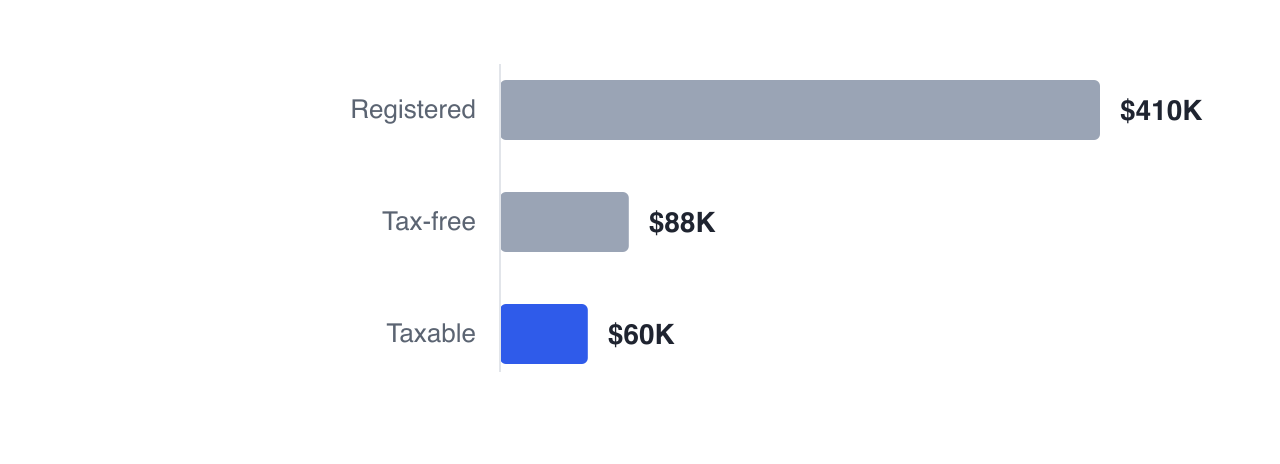
That third bar is also the honest limit on the idea. Asset location can only save tax on the income the taxable account generates, so the benefit scales with how much sits there. For a household whose savings are almost entirely registered, this is a smaller lever than the drawdown-order decisions earlier in this series.
When the engine can measure it, and when it cannot
By default the projection treats a non-registered account as pure deferral — nothing taxed until it is withdrawn — which says nothing about what the account holds. With no income mix to compare, a location change has no honest dollar figure, so for a plan like Priya’s the advice engine flags it as a consideration and says so. Describe how the account actually earns — its share of interest, dividends, foreign income and gains — and the engine taxes that income as it arrives, and measures what moving the interest-bearing part into a registered account would save. A number from a model that does not track the mechanic would be worse than no number; once it tracks it, the number is real.
The accounts view shows each balance separately across the whole projection, which is the first thing to know before deciding whether a location change is worth the complexity.
Next: inflation — the risk that never shows up on a statement.
GlidePathEngine is an educational planning tool — not financial, investment, tax, or legal advice.