Beneficiary designations versus your will
People write a will and consider their estate planning done. For several of the largest assets most households own, the will is not the controlling document — and the one that is was usually filled in years earlier, in a hurry, and never looked at again.
Which document controls what
Bypassing the estate has two consequences. It avoids probate, which is a saving. And it means the asset is unavailable to pay the estate’s debts and taxes — including the tax that the asset itself just triggered.
That second point produces the most damaging outcome in this whole area, and it deserves stating carefully: the tax on a registered account falls on the estate, while the money goes to the beneficiary.
The mismatch, worked through
Suppose a RRIF names one child as beneficiary and the will leaves the residue of the estate to another. The RRIF pays out directly to the first child. The full value of that RRIF becomes income in the final return, and the tax on it is an estate liability — paid from the residue, which belongs to the second child.
One child receives the account, the other pays the tax on it. Neither outcome was intended, both documents were valid, and the arithmetic is not obvious until it happens. An equal split by document can be a wildly unequal split after tax.
The TFSA distinction
A TFSA offers two options for a spouse, and they are not equivalent. A successor holder takes over the account itself — it continues as a TFSA, keeps growing tax-free, and does not consume any of their own contribution room. A beneficiary receives the value, and growth after the date of death becomes taxable.
Successor holder is available only to a spouse or common-law partner, and choosing it costs nothing. It is the single highest-value, lowest-effort item in this episode.
Where the tax lands
Dan & Marie — 58 and 56, Alberta. Dan retires at 62 with a defined-benefit pension; Marie retires at 60. Their RRSPs are very different sizes, which matters later.
Dan and Marie’s estate is $1,904,419 gross, with $156,244 of tax and $525 of probate. Almost all of that tax comes from registered accounts being collapsed into income. They live in Alberta, where probate is a flat fee that stops rising at $525, so the probate a designation saves them is small. The tax it can send to the wrong person is not.
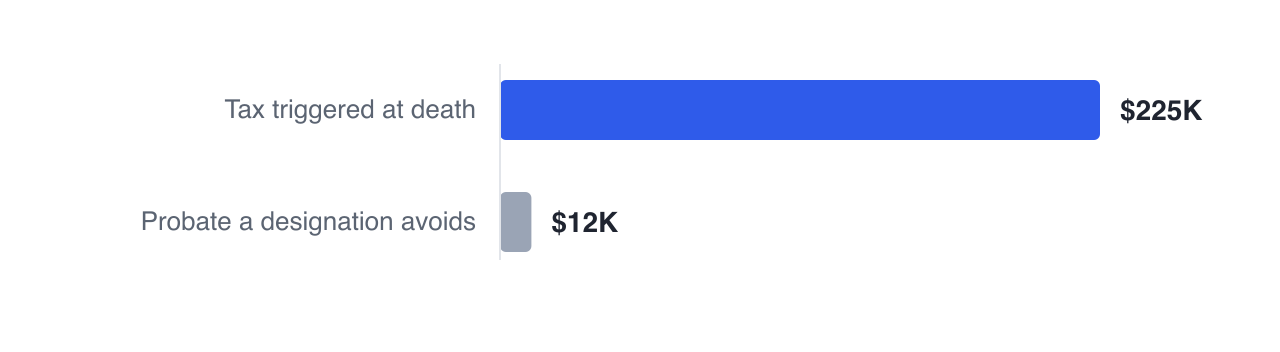
Look at the two bars together. A designation is often chosen to save the smaller number, and it moves the money away from the estate that owes the larger one. For a household leaving everything to a spouse the point is moot; for anything else it is the central problem.
The review, which takes an afternoon
List every registered account, every insurance policy and every pension. For each one, confirm who is named and when it was last confirmed. Check that a spouse on a TFSA is a successor holder rather than a beneficiary. Then check that the total picture — designations plus will — distributes the estate the way you intend after tax, not before it.
Quebec operates differently in several respects, and any of this involving minors, disabilities or blended families is genuinely a matter for a lawyer. The review is still worth doing yourself first, because the questions it raises are the ones worth paying to have answered.
The estate summary shows the tax the deemed disposition of your accounts produces — the liability that stays with the estate even when a designation sends the money elsewhere.
Next: leaving an estate on purpose rather than by accident.
GlidePathEngine is an educational planning tool — not financial, investment, tax, or legal advice.