Build your first plan in ten minutes
The reason most people never finish a retirement plan is that the form asks forty questions before it shows anything. Six of those questions carry almost all the signal — and you can answer them from memory.
The six that matter
| Input | What it drives |
|---|---|
| Your age and province | The entire tax calculation, and how many years the plan runs |
| When you want to stop working | The single largest lever in the whole projection |
| Account balances by type | What is taxable on the way out — episode 1’s three columns |
| Your income, and what you contribute | How much more gets added before you stop |
| What you want to live on | The target the drawdown has to hit each year |
| How long to plan for | How thin the money has to be spread |
Notice what is missing. Not asset allocation, not which funds you hold, not a detailed budget broken into categories. Those refine an answer; they do not produce one. The six above produce one.
The three inputs people get wrong
Balances by account type, not by institution. Your brokerage statement is organised by where the money is. A projection needs it organised by how it is taxed. An RRSP at one bank and an RRSP at another are the same line; an RRSP and a TFSA at the same bank are not.
Spending as a real, ongoing number. Not this month’s expenses, and not including the mortgage if it will be gone by then. The figure the projection wants is what a year of your retired life costs, in today’s money — which is the subject of episode 8, and worth a rough answer now and a better one later.
The expected return. This is the input where optimism is most expensive, because it compounds. A rate that is two points too generous does not make the plan look slightly better; over thirty years it changes the answer entirely. Leaving the default alone on a first pass is a genuinely reasonable choice.
Priya’s first pass, in three numbers
Priya — 54, Ontario, single. $118,000 salary, $410,000 in her RRSP and $88,000 in her TFSA, planning to retire at 63.
Priya answered the six. She is 54 in Ontario, stops at 63, wants $58,000 a year to live on, and plans to 90. Her balances went in by type. That is the whole plan — and it is already enough to produce the three numbers that describe her retirement.
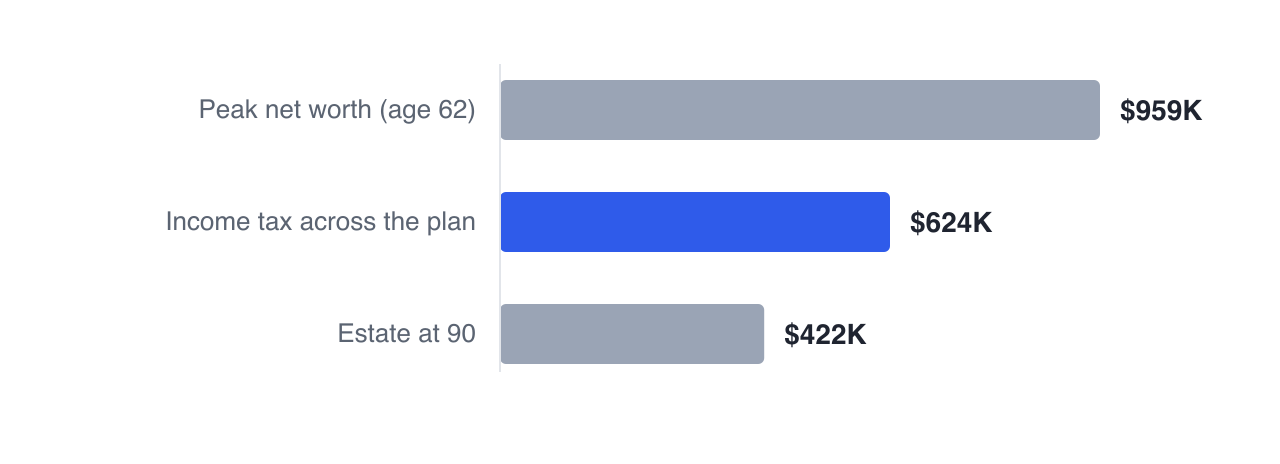
The tax figure is the one worth sitting with. $437,076 across the plan is more than her entire TFSA, more than her non-registered account, and it is the number most affected by decisions she has not made yet — when to start CPP, which account to draw from first, whether to withdraw from her RRSP before she has to.
That is the argument for building the rough plan early. Not because the first answer is right, but because it tells you which questions are worth your attention. For Priya, the answer is clearly the tax bar.
What to add on the second pass
- A spouse, if you have one — it changes the tax calculation more than any other single addition, because of splitting and survivor rules.
- Your home and any mortgage, so net worth is honest even though home equity is not spendable income.
- A defined-benefit pension, which behaves so differently from savings that it deserves its own line.
- One-off goals with real timing — a car, a renovation, a child’s tuition.
Guided Setup walks the six inputs above in order and shows the projection updating as you go. Nothing is saved to an account unless you choose to sign in.
Next: where RRSP contribution room comes from — and the part of it that quietly disappears.
GlidePathEngine is an educational planning tool — not financial, investment, tax, or legal advice.