The capital dividend account
Almost every route out of a corporation is taxed. There is one that is not, it is created automatically by ordinary investing, and it is routinely left unclaimed because nobody watched the balance.
Where the balance comes from
It is not a loophole. It is the system avoiding taxing an amount it deliberately chose not to tax. The same logic applies personally — you keep the untaxed half of a personal gain automatically — the CDA simply provides the plumbing to get it out of a company.
Life insurance proceeds received by a corporation also credit the CDA, less the policy’s adjusted cost base. That is the entire mechanism behind corporate-owned insurance planning: premiums are paid with lightly-taxed corporate dollars and the proceeds largely exit the company tax-free.
The rules that catch people
- Capital losses reduce the balance. A corporation with realised losses may have far less CDA than the gains alone would suggest.
- The balance must be positive at the moment of the election. It moves with every realisation, so a payment planned around last quarter’s figure can fail.
- A formal election must be filed before or with the dividend. Paying a capital dividend without one makes it an ordinary taxable dividend, and an excessive election carries a penalty tax.
- The balance dies with the corporation only if unused — which is why a wind-up or a sale is a natural moment to check it.
The timing point deserves emphasis. Because the balance fluctuates with every realised gain and loss, the practical discipline is to check it before any large distribution rather than once a year.
What accumulates alongside the portfolio
Sam — 41, British Columbia, self-employed through a corporation. No employer pension, no home yet, and a company that pays them both salary and dividends.
Sam’s corporation holds $180,000 of investments today and the company is worth $2,581,226 by 60. Every capital gain realised along the way credits half of itself to the CDA.
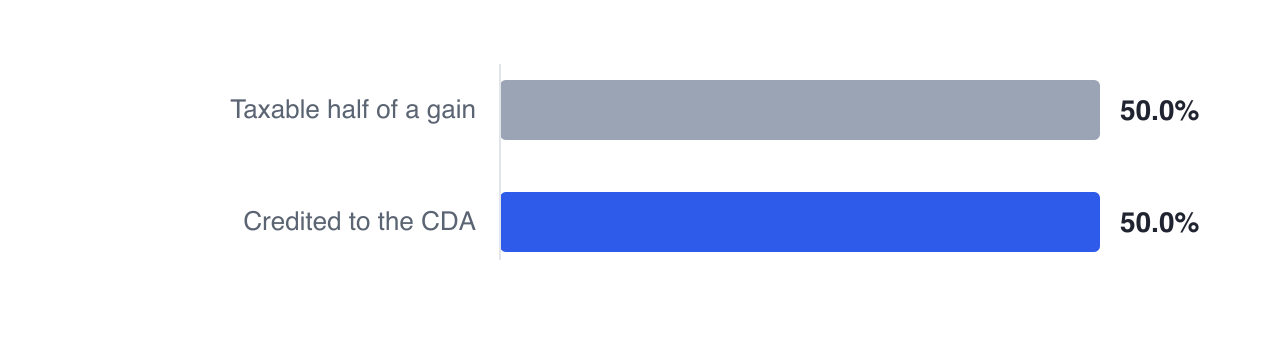
The practical consequence for a retired owner-manager is a genuinely free source of income — one that does not appear on a tax return at all, and therefore does not count toward the OAS recovery threshold or any other income test. Among all the levers in this series, very few have that property.
Deferral has a cost here
Episode 35 argued for deferring realisation. Inside a corporation there is a tension: an unrealised gain generates no CDA. Realising gains creates tax-free distribution capacity and also generates investment income that feeds the passive income grind from episode 61.
There is no general answer to that tension. It depends on the size of the operating business, how close the portfolio is to the grind threshold, and whether the shareholder actually wants distributions now. Which is precisely the kind of question a projection is better at than a rule.
The projection accumulates the capital dividend account as gains are realised and pays from it where it can — including stripping the remaining balance tax-free at the estate.
Next: TOSI — why paying your spouse a dividend is not as simple as it looks.
GlidePathEngine is an educational planning tool — not financial, investment, tax, or legal advice.