Capital gains: inclusion rate, ACB, deemed disposition
Non-registered investing looks like the least interesting of the three account types until you notice it has something neither of the others do: partial taxation, on your timetable. It also has one deadline nobody chooses.
The inclusion rate
For someone at a 37.2% marginal rate, that makes a dollar of capital gain roughly half as expensive as a dollar of interest. Which is why the same portfolio held in the same account can produce very different after-tax results depending on what kind of return it generates.
Adjusted cost base
Your adjusted cost base is what you paid, adjusted over time. The gain is the proceeds minus the ACB. Two things routinely go wrong with it: reinvested distributions increase the ACB and are often not tracked, and identical securities bought at different times across different accounts must be pooled into a single average cost.
The consequence of not tracking ACB properly is paying tax twice on the same money — once when a distribution was reported as income, and again as a gain because the cost base was never stepped up. It is one of the most common and least visible errors in non-registered investing.
Realisation is a choice, until it is not
An unrealised gain is not taxed. You choose when to sell, which means you choose when the tax happens — a genuine planning lever that registered accounts do not offer. A gain realised in a low-income year costs meaningfully less than the same gain realised in a high-income one.
Deemed disposition is the end of that choice. On death you are treated as having sold everything at fair market value, and the entire accumulated gain is realised in one final tax year. Decades of deferral arrive at once, usually at the highest rates the schedule offers.
The deferral, and the bill
Priya — 54, Ontario, single. $118,000 salary, $410,000 in her RRSP and $88,000 in her TFSA, planning to retire at 63.
Priya holds $60,000 in non-registered investments today, and the account grows across her plan without her paying tax on the growth as it happens. That deferral is worth real money over thirty-six years.
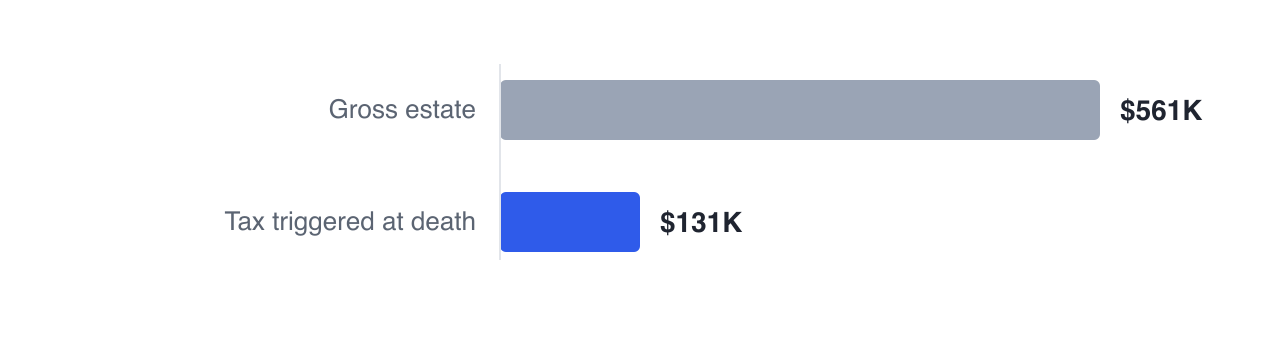
In the terminal year the arithmetic lands: her gross estate of $516,589 produces $109,987 of tax from the deemed disposition of everything she still holds — registered balances in full and non-registered gains at the inclusion rate.
A spouse changes this: assets roll over at cost base, deferring the disposition to the second death rather than the first. It is a deferral, not an exemption — the bill still arrives, once.
Why this shapes account choices
Because gains are partially taxed and deferrable, non-registered money is not simply "the account you use once the others are full". Its tax character differs by what it holds, which makes *where* each kind of asset sits a decision in its own right — the subject of a later episode in this series.
The estate summary decomposes the terminal year into gross estate, probate and the tax the deemed disposition triggers — so the deferred bill is visible decades before it arrives.
Next: dividends — the gross-up, the credit, and why "eligible" is not the same as "better".
GlidePathEngine is an educational planning tool — not financial, investment, tax, or legal advice.