Coast FI: the day you can stop contributing
There is a threshold most people pass without noticing, somewhere between starting to save and being able to stop working: the point where the balance you already hold will grow into your target on its own, if you simply leave it alone.
The definition
It is not retirement. You still need income to live on until the target arrives. What changes is the purpose of that income: it covers today rather than funding tomorrow, which is a different relationship with a job.
The real return is doing all the work
The single most common error in a Coast FI calculation is compounding at a nominal return. At 5% nominal and 2.1% inflation, the real rate is about 2.8% — barely half the headline figure.
Over twenty years that difference compounds into a very large discrepancy. Because a FI number is expressed in today’s purchasing power, the growth used to reach it has to be in today’s purchasing power too. Using the nominal rate makes Coast FI look several years closer than it is.
It is the same real-versus-nominal discipline as episode 38, applied to a calculation people usually do on the back of an envelope — which is exactly where the two conventions get mixed.
Priya, nine years from retirement
Priya — 54, Ontario, single. $118,000 salary, $410,000 in her RRSP and $88,000 in her TFSA, planning to retire at 63.
Priya is 54 and retires at 63 — nine years of compounding left. She holds $410,000 registered and $88,000 tax-free against a FI number of $2,950,000.
Nine years at 2.8% real multiplies a balance by roughly 1.29. Whether that carries her existing balances to the target without further contributions is precisely the Coast FI question, and the answer depends far more on the real rate than on the balance.
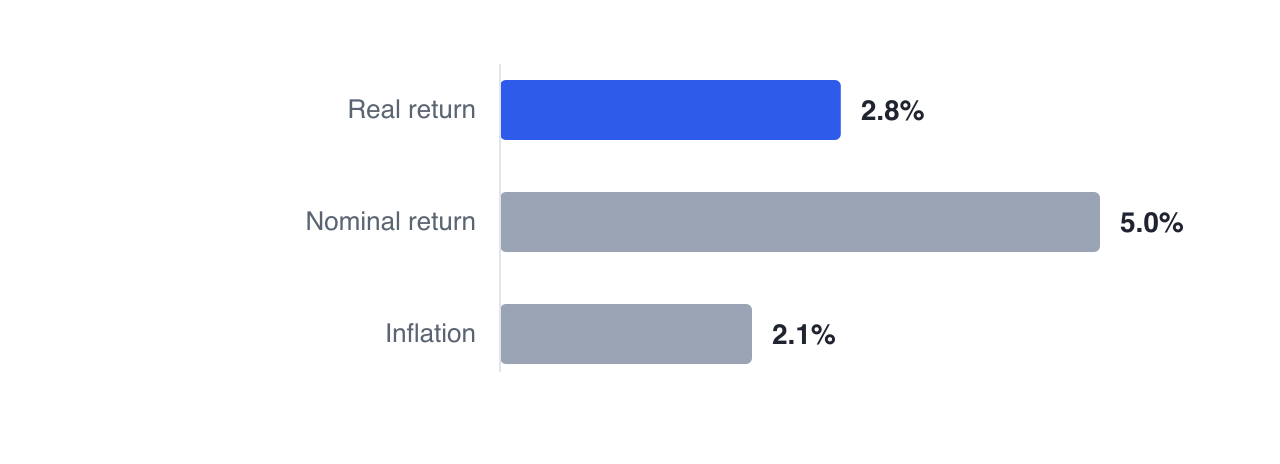
The gap between the first two bars is the entire error. It looks small annually and it is decisive over a decade — and it is the reason a Coast FI figure computed in a spreadsheet often disagrees with the one a projection reports.
What it is actually useful for
- Deciding whether a lower-paying but better job is affordable — Coast FI says the retirement is already largely funded, so the income only needs to cover living costs.
- Deciding whether part-time work or a career break is viable.
- Understanding what a market drop actually costs you: falling back below the threshold is a concrete, interpretable consequence rather than an abstract loss.
- Explaining why early contributions matter so much more than late ones. Coast FI arriving early is the compound-interest argument in a single number.
The FIRE calculator reports Coast FI alongside the FI number, computed at the Fisher-adjusted real return rather than the nominal one — so the threshold is not optimistic by construction.
Next: should you incorporate? The deferral advantage, the costs, and who it helps.
GlidePathEngine is an educational planning tool — not financial, investment, tax, or legal advice.