The CPP survivor’s pension
CPP does provide for a surviving spouse, which is more than can be said for OAS. What it provides is capped in a way that surprises almost everyone: a survivor who was already receiving a full pension may get nothing extra at all.
Two formulas, split at 65
A survivor aged 65 or over receives 60% of the deceased’s retirement pension. A survivor under 65 receives a different structure: a flat-rate portion of roughly $2,858 a year plus 37.5% of the deceased’s pension.
The under-65 formula can be worth more than the over-65 one for a smaller deceased pension, because the flat component does not scale. It is one of the few places in the system where being younger produces a larger benefit.
That cap is the single most consequential fact in this episode. Two people who each contributed at the ceiling for a full career do not produce a survivor entitlement between them — the survivor simply keeps their own pension and the household loses the other one entirely.
And the OAS pension pays nothing
The OAS pension has no survivor benefit. The deceased’s OAS — up to about $8,999 a year of indexed, guaranteed income — stops. The one exception is narrow: a low-income widow or widower aged 60 to 64 may qualify for the income-tested Allowance for the Survivor, which ends at 65. From 65 on there is nothing, so for a couple whose retirement income leaned on both benefits this is a permanent reduction.
CPP also pays a one-time death benefit of about $2,500 to the estate. It is a contribution toward funeral costs rather than a financial provision, and it should not appear in a plan as anything more than that.
Marie hits the cap
Dan & Marie — 58 and 56, Alberta. Dan retires at 62 with a defined-benefit pension; Marie retires at 60. Their RRSPs are very different sizes, which matters later.
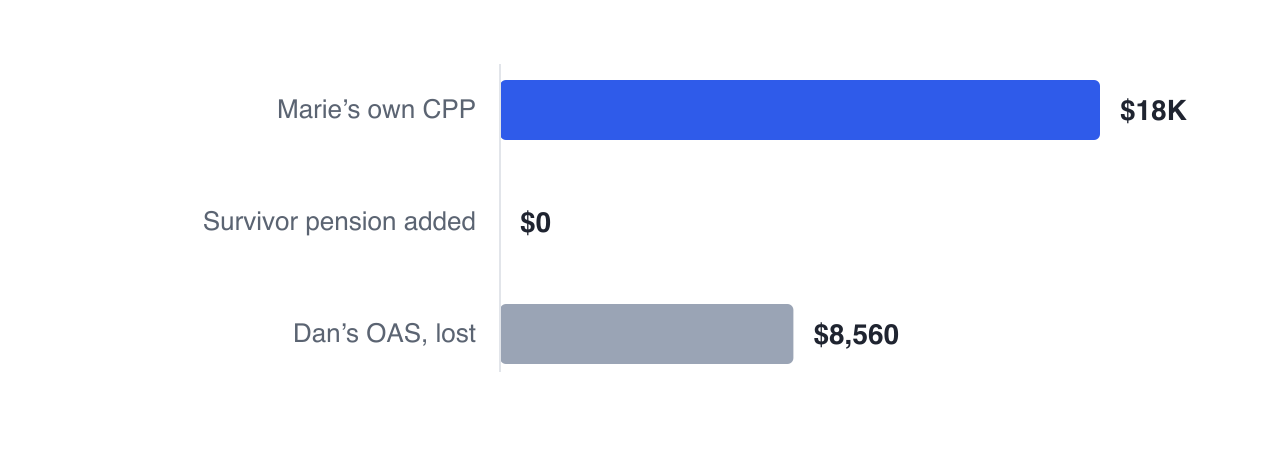
Marie is already receiving a full $18,092 CPP pension of her own. Because that is the maximum, the combined cap means Dan’s death adds nothing to her CPP — her benefit in the first survivor year is exactly what it was the year before.
Her own OAS of $8,999 continues, and Dan’s stops. So the household’s guaranteed government income falls by a full OAS and a full CPP, and the survivor provision recovers none of it.
The mirror image is worth noting. A survivor with little CPP of their own — a spouse who spent years out of the workforce — has plenty of headroom under the cap and receives close to the full survivor formula. The provision is most generous exactly where the need is greatest, and worthless where both spouses earned well.
One administrative note
The survivor’s pension is not automatic — it requires an application, and it is not paid retroactively without limit. It also has no relationship to who was named on any beneficiary form; it flows from the contributory record and the marital relationship, not from a designation.
The projection applies the survivor pension with its age bands and combined cap from the year after a death, and stops the deceased’s OAS — so the ledger shows the survivor’s real income rather than an assumed fraction.
Next: long-term care — the late-life cost that breaks otherwise sound plans.
GlidePathEngine is an educational planning tool — not financial, investment, tax, or legal advice.