The CPP timing decision: 60, 65 or 70
The usual framing is a break-even age: defer, and you come out ahead if you live past some number in your late seventies. That framing is arithmetically correct and quietly incomplete, because it treats the pension as the only thing the decision touches.
The adjustment factors
CPP can start as early as 60 and as late as 70. Starting before 65 reduces the benefit permanently — 36.0% at the earliest age. Starting after 65 increases it permanently, by 42.0% at the latest. Those adjustments are per month, they are published rules rather than estimates, and they never reverse.
Why the break-even age answers the wrong question
A break-even calculation compares total dollars received under two start ages and finds the age where the later start overtakes the earlier one. It assumes the money is otherwise identical, and in a real plan it is not — for three reasons.
- The money you spend while waiting comes from somewhere. Usually a registered account, which means the deferral is partly funded by withdrawals that are themselves taxable.
- CPP is taxable income, so a larger pension can raise your income into a clawback range later — the benefit and the tax move together.
- Deferring drains registered balances earlier, which shrinks the forced withdrawals that begin in your seventies. That is a second-order effect the break-even never sees.
None of that makes deferral better or worse. It makes the honest comparison a whole-plan one rather than a two-line one.
Dan & Marie, three start ages
Dan & Marie — 58 and 56, Alberta. Dan retires at 62 with a defined-benefit pension; Marie retires at 60. Their RRSPs are very different sizes, which matters later.
Running their plan with both spouses starting CPP at each of the three reference ages, lifetime CPP received rises from $785,184 at 60, to $995,049 at 65, to $1,156,066 at 70. That is the break-even calculation’s view, and on it deferral wins clearly.
Lifetime income tax moves the same way: $654,385 starting at 60 against $839,771 starting at 70. More pension is more taxable income, every year, for life.
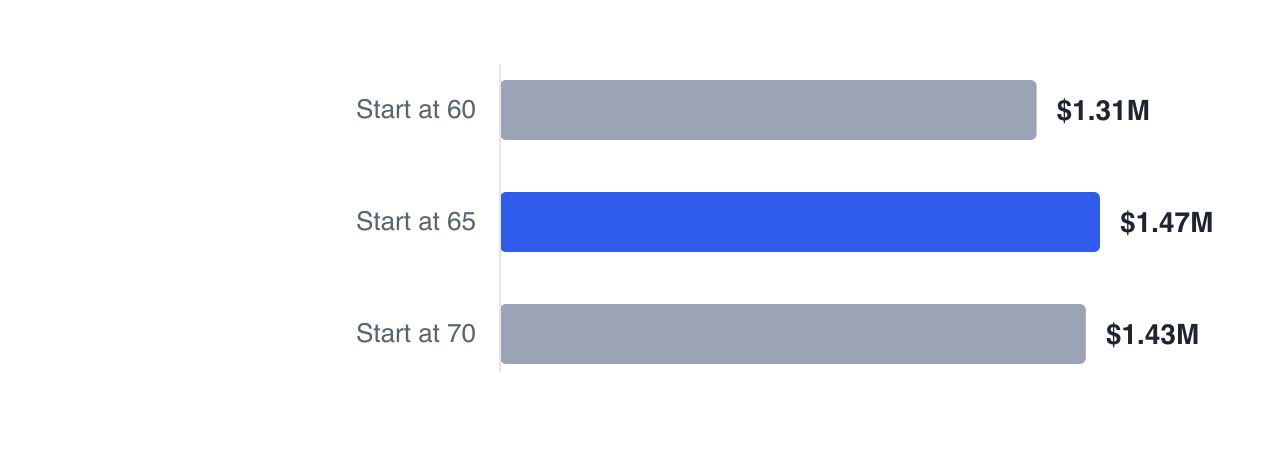
Notice what happened. Deferring to 70 gave them the most CPP by a wide margin and did *not* give them the best whole-plan result, because the extra pension arrived alongside extra tax and had to be funded in the meantime from their own accounts. For a household with a different income shape the ordering flips — which is exactly why a general rule cannot settle this.
How to actually decide
Score the start ages against your own plan rather than against a break-even table. The timing optimizer runs a grid of CPP and OAS start-age pairs — jointly, because the two interact through the clawbacks — and reports the outcome of each on your numbers. Where the grid is flat across several ages, the decision genuinely does not matter much, and that is useful information too.
The optimizer scores every start-age pair against your plan and shows the grid, so you can see whether your answer is a sharp peak or a broad plateau before committing to it.
Next: OAS — the benefit you qualify for by living here, and can lose by earning.
GlidePathEngine is an educational planning tool — not financial, investment, tax, or legal advice.