What happens financially when one spouse dies
The financial consequences of losing a spouse are rarely discussed in advance, and they are not proportional: household income can fall by half while the survivor’s need falls by far less, and what is left is taxed on one set of brackets instead of two.
What rolls over
Registered accounts — RRSP, RRIF, locked-in accounts — roll to a surviving spouse tax-free where the spouse is named. A TFSA can pass to a spouse as a successor holder, keeping its tax-free status and not consuming the survivor’s own room. Non-registered assets transfer at cost base rather than at market value, deferring the gain to the second death.
What stops
- The deceased’s OAS, entirely. There is no survivor benefit — roughly $8,999 a year of indexed income simply ends.
- The pension income split, because the election needs two living spouses. Income that was spread across two returns now lands on one.
- The second set of brackets and credits. The same household income is taxed on one progressive schedule instead of two.
- Any workplace pension, reduced to whatever survivor percentage was elected at retirement — sometimes 60%, sometimes nothing.
CPP is the partial exception: a survivor’s pension continues, subject to age bands and a combined cap. It is the subject of the next episode, and it does not come close to replacing the lost benefits in full.
Why the survivor can be worse off proportionally
A single person does not need half of what a couple needs. Housing, property tax, insurance, a car and most fixed costs barely move. Estimates commonly put a survivor’s requirement at around three-quarters of the couple’s spending — against an income that has lost one OAS, part or all of a pension, and the ability to split.
Marie, on her own
Dan & Marie — 58 and 56, Alberta. Dan retires at 62 with a defined-benefit pension; Marie retires at 60. Their RRSPs are very different sizes, which matters later.
In the last year both are alive — Dan at 89 — the household has $151,014 of gross income against a $96,000 target, and pays $25,220 of income tax across two returns.
The year Dan dies still carries his own final return — his income up to the date of death, taxed on his brackets — so it looks almost unchanged. The year after is the real picture. Dan’s pension, CPP and OAS — $65,091 a year — have stopped, and Marie alone reports $78,396 of gross income against a $67,200 target, paying $9,461.
Her tax bill is smaller, because her income is. The rate is not: the next dollar she draws is taxed at 30.5%, exactly the 30.5% each of them faced as a couple — on about half the household income, because it now sits on one return. And the target fell by less than a third while the income nearly halved. The rolled-over RRIF is what closes that gap: its minimum is now drawn on the whole combined balance.
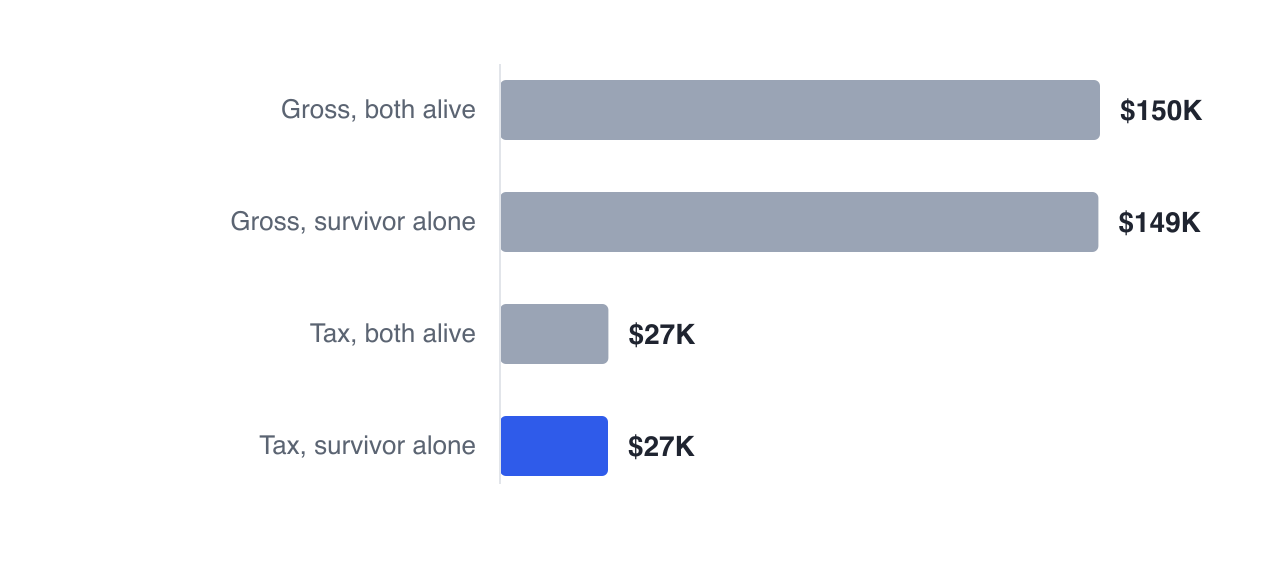
Their plan holds because the whole registered balance rolls to Marie, and the minimum she must now draw from it covers most of her target on its own. Take the rollover away — a household whose savings sat mostly in a pension with no survivor percentage — and the same $65,091 disappears with nothing behind it, which is, again, an argument that started in the spousal RRSP episode.
What helps, decided in advance
Naming a spouse as successor holder rather than beneficiary on a TFSA, keeping beneficiary designations current, choosing a survivor percentage on a pension with the survivor’s position in mind, and balancing registered savings between spouses during the working years. Each is a decision made long before it matters.
The projection carries the household through both deaths, applying the rollover, ending the deceased’s OAS and dropping the split — so the survivor years appear in the ledger rather than being assumed away.
Next: the CPP survivor’s pension — age bands, the combined cap, and why OAS has none.
GlidePathEngine is an educational planning tool — not financial, investment, tax, or legal advice.