Defined benefit vs defined contribution
Both are called pensions and both come out of an employer. One of them tells you what you will receive; the other tells you what will be paid in. That single difference decides who is holding the risk for the next forty years.
Defined benefit: the employer promises an income
A defined benefit plan calculates your pension from a formula — typically years of service multiplied by a percentage of an average salary. The employer is then obliged to pay that amount, whatever the plan’s investments did. Market losses are the sponsor’s problem. Living to 100 is the sponsor’s problem.
Two features vary between plans and are worth checking rather than assuming: whether the pension is indexed to inflation, and what survivor percentage continues to a spouse. An unindexed pension loses purchasing power every year of a long retirement, which is invisible on the day it starts and substantial two decades in.
Defined contribution: the employer promises a deposit
A defined contribution plan puts a specified amount into an account with your name on it. What that becomes depends on the investments, and what income it eventually supports depends on the balance, the withdrawal rate and how long you live. The employer’s obligation ends when the deposit clears.
How each appears in a projection
A defined benefit pension enters as an income stream, starting at a given age and continuing for life. There is no balance behind it and nothing to draw down. A defined contribution plan is modelled as a registered account balance, because that is what it is — it grows, it is drawn down, and it is subject to the same mandatory withdrawal schedule as an RRSP.
One tax detail applies to both: pension income qualifies for a modest federal pension income credit — around $2,000 of income sheltered — and, for couples, becomes eligible to be split with a spouse. That eligibility is worth far more than the credit, and it is the subject of a later episode.
A household with one of each
Dan & Marie — 58 and 56, Alberta. Dan retires at 62 with a defined-benefit pension; Marie retires at 60. Their RRSPs are very different sizes, which matters later.
Dan retires at 62 with a $38,000 defined benefit pension. Marie has no pension — her retirement income comes from a $165,000 RRSP and her share of the household’s other savings. They are the same household with two completely different risk positions inside it.
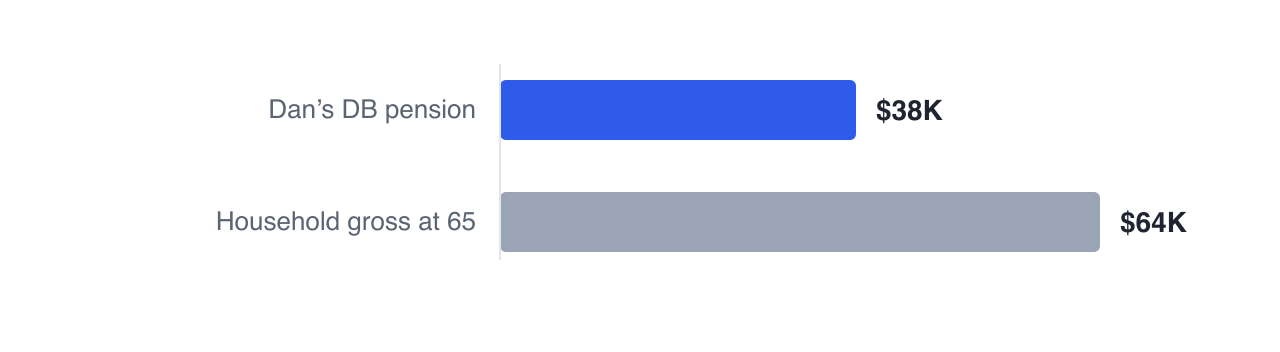
The practical consequence shows up in how much volatility the plan can absorb. The pension is a floor that does not move, so a market downturn threatens only the portion above it. A household with no pension at all has no floor except CPP and OAS, and needs correspondingly more margin.
Why it changes the rest of the plan
A large indexed pension covers a lot of essential spending, which changes what the portfolio is for and how much certainty it needs to deliver. It also raises taxable income every year, which interacts with clawbacks and makes the drawdown ordering decisions later in this series sharper rather than softer.
The income section takes a defined benefit pension with a start age, either as a known annual amount or estimated from a service-and-salary formula — and a defined contribution balance belongs in the accounts section as registered savings.
Next: the deadline at 71 that every RRSP holder eventually meets.
GlidePathEngine is an educational planning tool — not financial, investment, tax, or legal advice.