Disability insurance and the self-employed gap
Before 65, a working person is more likely to experience a disability lasting several months than to die. Households insure the second event routinely and the first one patchily, and the financial consequences of the first are arguably worse.
Why it is worse than it sounds
A death removes income and also removes a person’s expenses. A disability removes income and adds expenses — treatment, equipment, home modification, sometimes paid help. The household continues at close to full cost with a fraction of the earnings.
It also stops retirement saving at exactly the moment the plan needed it most, and often starts drawing down savings a decade or more early. The compounding effect on a retirement plan is far larger than the income lost during the disability itself.
The other terms worth reading
- The elimination period — how long before benefits start. A longer wait cuts the premium and requires savings to bridge the gap.
- The benefit period — how long payments continue. To 65 is the meaningful standard; two years is a very different product sold at a similar-sounding price.
- Whether benefits are indexed. A fixed nominal benefit across a twenty-year disability loses much of its value, for the reasons episode 38 covers.
- Whether the policy is non-cancellable — the insurer cannot change the premium or terms — or merely guaranteed renewable.
One tax detail that changes the amount needed: if you pay the premiums personally with after-tax dollars, benefits are received tax-free. If an employer pays them, benefits are taxable. The same headline coverage is worth materially different amounts depending on which applies.
Sam has no group plan behind them
Sam — 41, British Columbia, self-employed through a corporation. No employer pension, no home yet, and a company that pays them both salary and dividends.
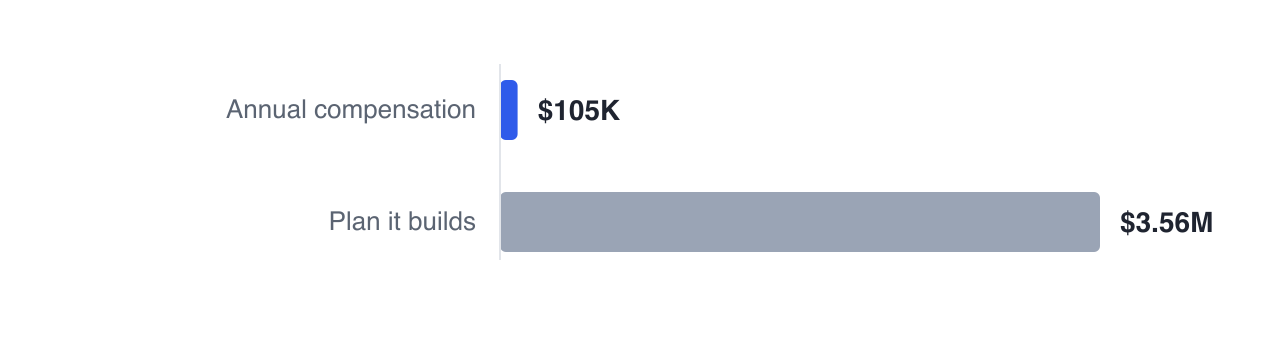
Sam is 41, self-employed through a corporation, taking $85,000 in salary and $105,000 in total compensation. There is no employer group plan, no sick leave, and no colleague covering the work. If Sam cannot work, the business income that funds everything stops.
Their plan projects $3,427,793 by the end, built on that income continuing to 60. Nineteen more years of it is the assumption the whole projection rests on, and it is the assumption a disability removes.
An employee in the same position usually has some group long-term disability coverage, often replacing a percentage of salary to 65, taxable, with an "any occupation" definition after two years. Imperfect, and enormously better than nothing. The self-employed have to buy the equivalent deliberately or go without.
How it shows up in a projection
A disability is, in plan terms, an early and involuntary end to earning that leaves spending in place. The planner takes a disability onset age for each person: from that age their salary stops, the CPP disability benefit starts, any policy you have entered pays after its waiting period, and savings start funding spending years early. Running it once with no policy shows exactly what coverage would be protecting.
For an incorporated owner like Sam, the onset age reaches the corporation too: it stops paying Sam a salary and its business income stops, because an owner-operated business stops earning when its owner stops working. The fixed dividend keeps coming out of the corporation’s savings, and Sam’s own accounts fund the rest — which is exactly the drawdown a policy would be there to prevent.
Set a disability onset age in the Health & Disability group and let the projection re-run. The gap between that plan and your baseline is the amount a disability policy would be standing in for — and adding the policy shows how much of it the policy closes.
Next: your home — an asset, and not a retirement plan.
GlidePathEngine is an educational planning tool — not financial, investment, tax, or legal advice.