Dividends: gross-up, the credit, and why eligible ≠ better
Dividend taxation is the strangest arithmetic in the Canadian system: you report more income than you received, pay tax on the inflated number, then get a credit back. The mechanism makes sense. Its side effect catches people every year.
Why the gross-up exists
A dividend is paid out of corporate profits that have already been taxed once. The integration principle says a dollar earned through a corporation and paid out to an individual ought to face roughly the same total tax as a dollar earned directly. The gross-up and credit are how the system attempts that.
The rates differ by dividend type. An eligible dividend — paid from income taxed at the general corporate rate — is grossed up by 38% with a correspondingly larger credit. A non-eligible dividend, paid from income taxed at the small business rate, is grossed up by 15% with a smaller credit.
Why "eligible" is not simply better
An eligible dividend carries a lower personal tax rate, so in isolation it looks preferable. But it came from corporate income taxed at the higher general rate. Comparing only the personal side is comparing half the transaction — the combined corporate-plus-personal burden is what integration is about, and the two dividend types are much closer on that basis than on the personal one.
For a business owner deciding how to pay themselves, this is the entire point: the question is never "which dividend is taxed less" but "what is the total tax on this dollar from the moment the business earned it".
The side effect that costs retirees money
Income-tested benefits are measured against net income, and net income includes the grossed-up dividend rather than the cash you received. The credit reduces your tax; it does not reduce the income figure the tests use.
So a retiree living on eligible dividends is measured against roughly 138% of what actually arrived in their account. Against an OAS recovery threshold near $95,323, that phantom income can trigger a clawback on money never received — the single most surprising interaction in retirement tax.
Sam’s dividends, grossed up
Sam — 41, British Columbia, self-employed through a corporation. No employer pension, no home yet, and a company that pays them both salary and dividends.
Sam’s corporation pays them $20,000 a year alongside a salary, and $1,020,000 across the whole plan. It earns at the small business rate, so every one of those dividends is non-eligible: grossed up by 15%, not 38%. Each is taxed on the grossed-up figure and credited back — and each counts against the benefit tests at that figure.
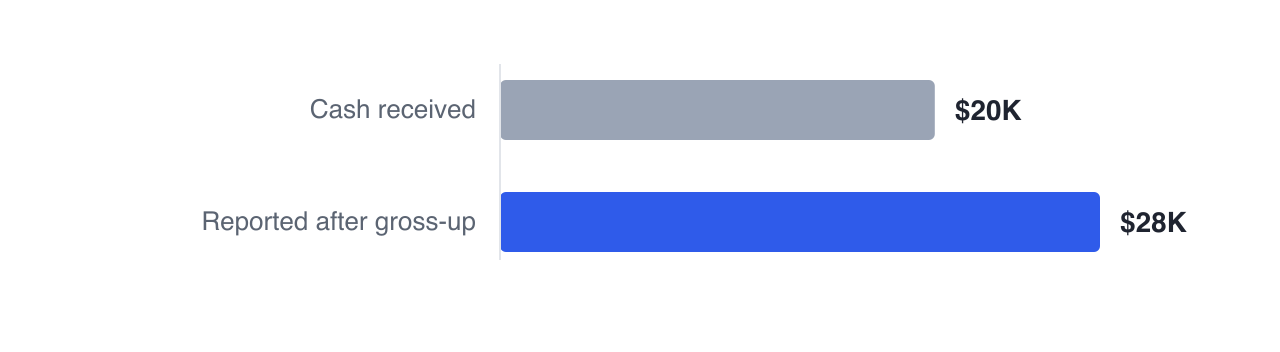
The projection handles this the way the tax system does: it keeps the cash figure as the money available to spend, and uses the grossed-up figure as the basis for clawbacks and income-tested credits. Those are genuinely two different numbers, and collapsing them into one is how a plan quietly understates a clawback.
Foreign dividends are a different animal
The gross-up and credit apply only to dividends from Canadian corporations. Foreign dividends are taxed as ordinary income at your full marginal rate, and may carry foreign withholding tax on top. That difference is one of the main inputs to the asset location question in the next episode.
Where a plan includes dividends, the projection applies the gross-up and credit and tests benefits against the grossed-up figure — so a clawback caused by phantom income appears rather than being rounded away.
Next: asset location — same portfolio, different accounts, different after-tax result.
GlidePathEngine is an educational planning tool — not financial, investment, tax, or legal advice.