Drawdown order: "TFSA first" is a default, not an answer
Faced with three accounts and a spending need, most people reach for the one with no tax consequence. It is the least stressful choice to make and, in a surprising number of plans, the most expensive one to have made.
Why the intuitive order feels right
Spending the TFSA first minimises tax this year. That is real, it is visible, and it is easy to verify on a tax return. Every alternative involves paying tax sooner in exchange for something that only shows up years later, which is a much harder trade to feel confident about.
The problem is that a retirement plan is not a series of independent years. Money left in a registered account does not sit still — it grows, and at 71 it converts into an account with a mandatory withdrawal schedule that rises annually for the rest of your life. Deferring tax is not the same as avoiding it.
The three orders worth knowing
- Tax-free first — TFSA, then non-registered, then registered. Lowest tax early, largest registered balance arriving at the mandatory schedule.
- Registered first — draw the RRSP down before the schedule can, preserving the TFSA to the end. Higher tax early, much smaller forced withdrawals later, and the TFSA passes on without tax.
- Blended — draw proportionally across accounts to keep taxable income level from year to year, avoiding both the early spike and the late one.
None of these is universally correct. Which one wins depends on the size of the registered balance relative to spending, on how far income sits from a clawback threshold, and on how long the plan runs.
The same assets, three orders
Dan & Marie — 58 and 56, Alberta. Dan retires at 62 with a defined-benefit pension; Marie retires at 60. Their RRSPs are very different sizes, which matters later.
Running Dan and Marie’s plan three times — identical household, identical spending, identical returns, only the withdrawal order changed — the plan ends at $1,747,650 drawing tax-free first, $1,911,293 drawing proportionally, and $1,968,400 drawing registered accounts down first.
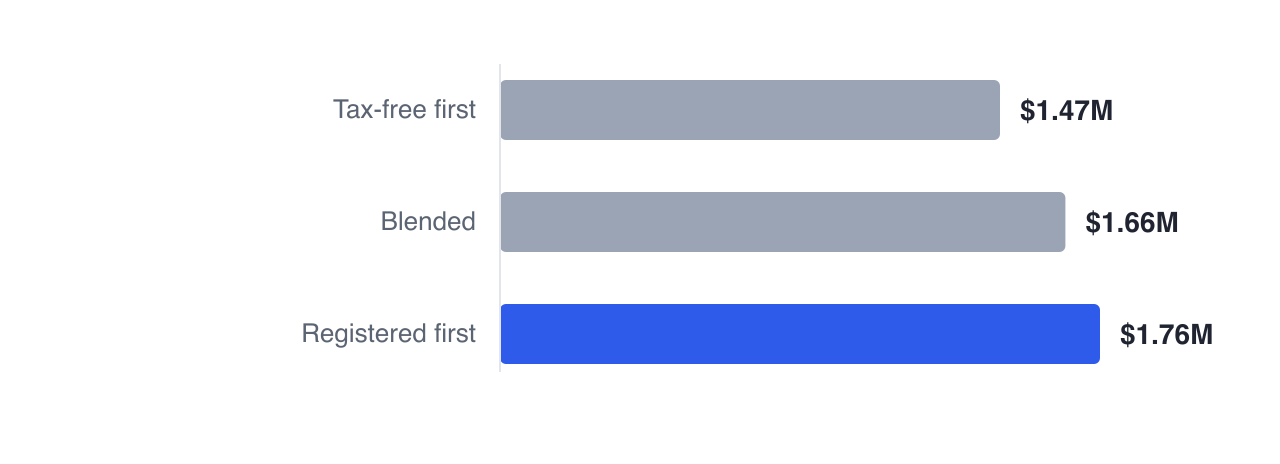
The ordering here reflects their situation: large registered balances and a defined benefit pension already filling the lower brackets, so the forced withdrawals later arrive on top of income rather than instead of it. A household with a small registered balance and no pension can easily produce the opposite ranking.
Why this is worth the effort
Most levers in a retirement plan cost something to pull. Saving more means spending less; retiring later means working longer; taking more risk means accepting more variance. Withdrawal order costs nothing at all — the same money funds the same lifestyle either way. It is close to the only free decision on the list.
There is a psychological dimension too, and it is worth naming rather than dismissing. Drawing a registered account down early means watching a large balance shrink while paying visible tax, in exchange for a benefit that only materialises much later. That is genuinely uncomfortable, and it is the reason many households default to the tax-free order even when they have seen the comparison.
The strategy comparison runs your plan under each withdrawal order and shows the outcomes side by side, so the choice is made against your numbers rather than a general principle.
Next: the two named strategies behind those bars, and what each is actually optimising.
GlidePathEngine is an educational planning tool — not financial, investment, tax, or legal advice.