Emergency fund versus investing
The standard framing pits an emergency fund against investing, as though the money has to be in a chequing account earning nothing. That framing is what makes the trade-off look painful, and it is not the only option.
What the buffer is for
Not "emergencies" in the abstract. Specifically, it exists so that an income interruption or an unexpected expense does not force you to sell investments at a bad time or borrow at a high rate. That is the whole function, and it defines how much you need.
The relevant figure is essential monthly spending, not total spending. Discretionary costs stop during a genuine interruption, so sizing the buffer against a full month of normal life overstates it.
The cost, honestly
Holding a buffer in cash forgoes the real return the money would otherwise have earned — about 2.8% a year in the assumptions used throughout this series. On a buffer of a few months’ spending that is a real but modest annual cost, and it buys the ability to not sell into a downturn.
The comparison people forget is what the buffer prevents. Selling equities down twenty percent to cover three months of expenses, or carrying credit card debt at a rate several times any expected return, is far more expensive than a few years of forgone growth on a modest cash balance.
Where it sits matters more than whether it exists
A buffer does not have to sit in a chequing account. Held inside a TFSA — in a high-interest savings or money-market holding — it earns interest tax-free and remains withdrawable at any time. That combination removes most of the cost of the framing this episode started with.
There is one caveat, and it is the recontribution rule from episode 7: TFSA room withdrawn mid-year does not come back until January. A buffer that gets used in June cannot be refilled until the new year, on top of the $7,000 annual limit. That is a timing constraint rather than a loss.
What a buffer should not be is an RRSP. Withdrawing from one is fully taxable and the contribution room is gone permanently — the single most expensive place to keep money you might need at short notice.
Priya’s buffer, sized and located
Priya — 54, Ontario, single. $118,000 salary, $410,000 in her RRSP and $88,000 in her TFSA, planning to retire at 63.
Priya spends $58,000 a year, so three months of full spending is about $14,500 and essential-only spending would be less. Against a TFSA of $88,000, a buffer of that size fits inside the account she already has.
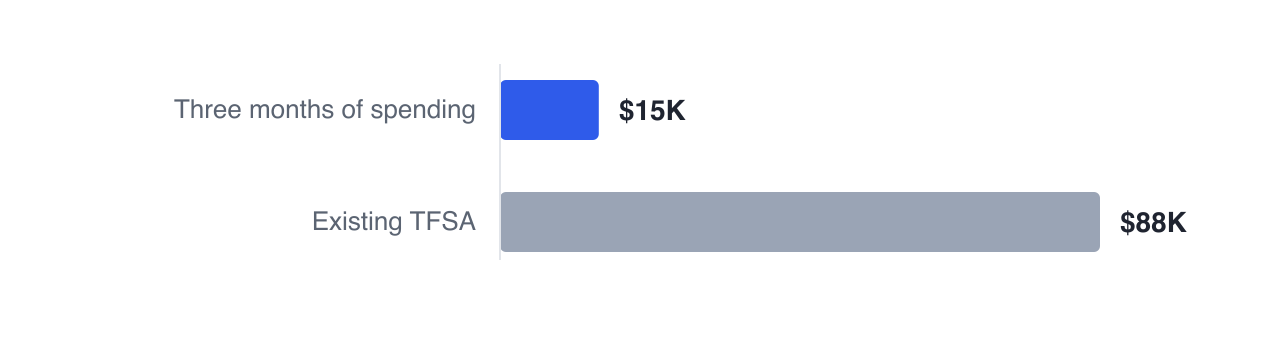
Framed that way the trade-off largely dissolves. She is not choosing between a buffer and investing — she is choosing what a slice of an account she already holds is invested in, which is a much smaller decision than the framing suggested.
And in retirement it changes shape
A retiree has no employment income to interrupt, so the buffer’s purpose shifts entirely to the sequence-risk problem from episode 24: holding a year or two of spending in something stable so a market decline does not force selling. Same instrument, different reason, and usually a similar size.
The accounts section shows each balance separately, so you can see whether a buffer fits inside existing tax-free room rather than needing a separate cash account.
Next: debt in retirement — which kinds are fine, and which are not.
GlidePathEngine is an educational planning tool — not financial, investment, tax, or legal advice.