Optimizing for estate versus optimizing for spending
Advice is only meaningful relative to a goal. "This improves your plan" means nothing until someone says what improvement is — and the two candidates pull in different directions often enough to matter.
The two metrics
Crucially, the spending target is held constant between a baseline and any counterfactual. So an estate improvement means "same lifestyle, more left over" and a spending improvement means "more lifetime cash for the same plan shape". Neither is achieved by quietly spending less.
Where they disagree
Deferring CPP raises lifetime guaranteed income and can lower the terminal estate — better on spending, worse on estate. Preserving a TFSA for a tax-free transfer improves the estate and forgoes drawing on it earlier. A meltdown pays tax sooner to leave more later. Each of those is a real trade rather than a free improvement.
This is why the advice engine reports the cross-objective effect alongside the headline one. A recommendation that gains on your active objective and loses on the other is flagged as exactly that, rather than presented as an unambiguous win.
Why there is deliberately no blended score
It would be easy to combine the two into one number with a weighting. It would also be fabricated: the weighting would be invented, and it would produce a precise-looking figure that encodes a value judgement nobody made.
Reporting both and flagging the conflict is less tidy and more honest. The trade-off between leaving money and spending it is not an arithmetic question, and a tool that answers it for you has overstepped.
Two numbers from one projection
Priya — 54, Ontario, single. $118,000 salary, $410,000 in her RRSP and $88,000 in her TFSA, planning to retire at 63.
Priya’s plan produces $2,512,932 of lifetime after-tax income and leaves $399,597 at the end. Those are both outputs of the same projection, and a strategy change moves them independently.
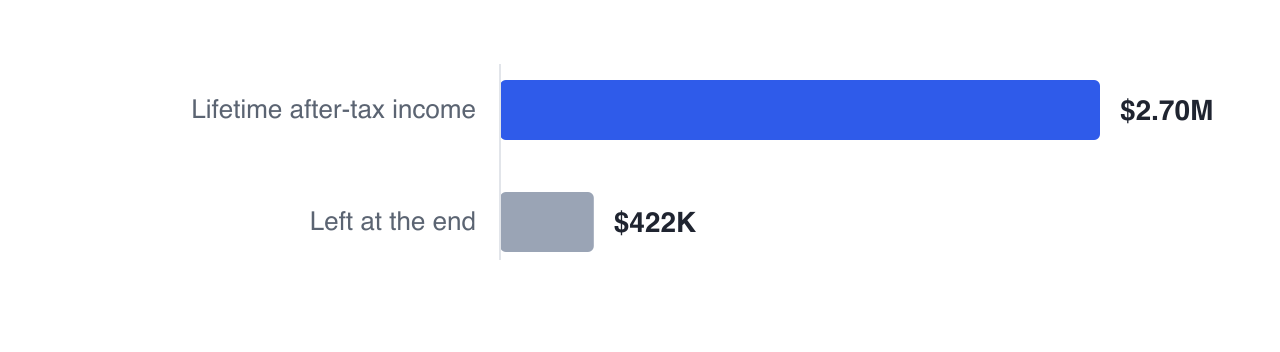
Episode 23 found a couple where the two measures happened to agree: the drawdown order that leaves $1,968,400 also pays less lifetime tax than the one that leaves $1,911,293. They do not always agree, and when they differ, which is better depends entirely on which of the two bars above you care about.
Choosing yours
A household with dependants, a family business, or a specific bequest in mind has a real estate objective. A household with no dependants, or one whose children are comfortable, usually has a spending objective and has never said so. Most people are somewhere between and lean one way.
It is a five-second setting and it changes what every recommendation in the plan is measured against. Worth five seconds.
A practical note on how the two metrics behave. The estate figure is a single terminal number and therefore sensitive to the horizon you assumed; the spending figure accumulates across every year and is correspondingly steadier. Where the two objectives disagree only slightly, that difference in sensitivity is often the reason — and it is a signal the choice between them does not matter much for your plan.
The objective toggle switches between the two, re-scoring every recommendation and reporting the effect on both — so a change that helps one and hurts the other is visible.
Next: how the advice engine actually measures a recommendation.
GlidePathEngine is an educational planning tool — not financial, investment, tax, or legal advice.