Estate-optimized vs tax-optimized drawdown
It is tempting to assume the strategy that pays the least tax is the strategy that leaves the most money. Those are two different questions, and a plan can answer one of them well while answering the other badly.
Two strategies, stated plainly
Estate-optimized draws the most heavily taxed accounts down first — registered money, then locked-in, then non-registered — leaving the TFSA untouched until the end. The logic is that a TFSA passes to a beneficiary with no tax at all, so it is the worst account to have spent and the best one to have kept.
Tax-optimized draws proportionally across accounts, deliberately keeping taxable income level from year to year. Levelling income avoids both the early spike from draining a registered account fast and the late spike when mandatory withdrawals arrive on a balance that was left to grow.
Why the winner is not obvious
Every dollar left in a registered account at death is taxable in the terminal return, typically all at once and therefore at a high rate. A strategy that carefully avoided tax for thirty years by leaving that account alone hands the whole deferred bill to the estate at the least favourable moment available.
Running the other way, a strategy that empties the registered account aggressively pays more tax earlier — sometimes at higher rates than necessary, sometimes triggering clawbacks — in exchange for a smaller final bill and a preserved TFSA.
Both scoreboards for the same household
Dan & Marie — 58 and 56, Alberta. Dan retires at 62 with a defined-benefit pension; Marie retires at 60. Their RRSPs are very different sizes, which matters later.
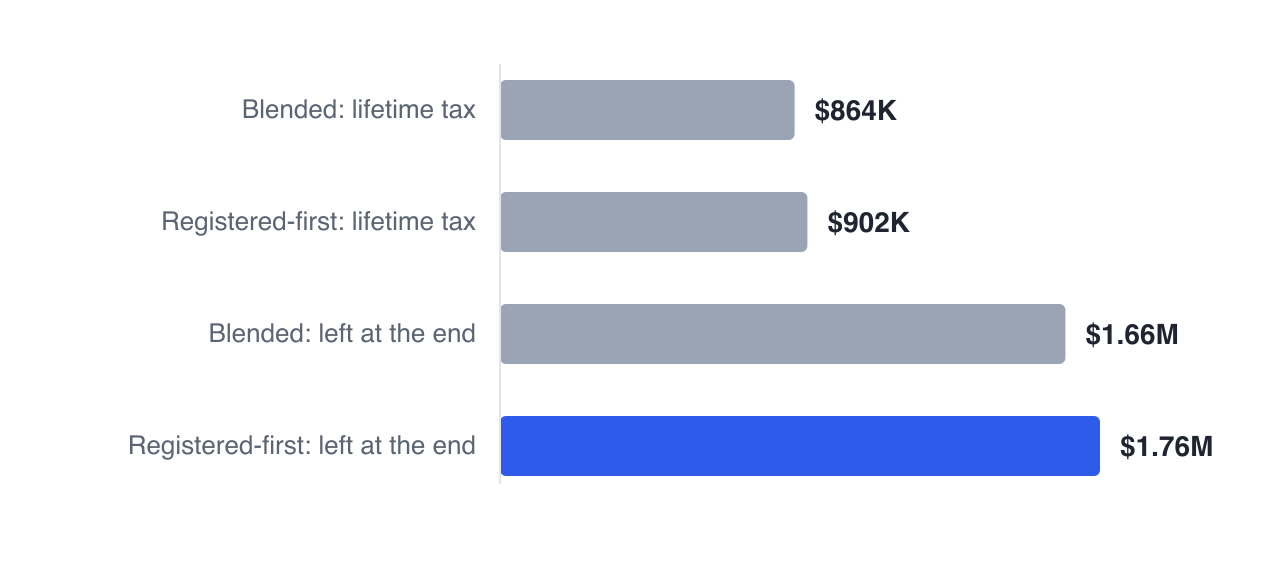
On lifetime income tax, tax-optimized pays $685,046 against estate-optimized’s $680,452. On what is left at the end, it is $1,968,400 for estate-optimized against $1,911,293.
Read those two pairs again, because this is the part worth slowing down for. For this household, the strategy called tax-optimized does not win the tax scoreboard — it pays more. It also leaves less. It wins neither.
That is not a flaw in the strategy and it does not collapse the distinction. The two scoreboards really are different questions; they simply happen to point the same way here, because drawing the registered balance down early both spreads the income across more years *and* shrinks the balance the terminal return taxes. A strategy’s name describes what it tries to do. It is not a promise about how it lands on your numbers — which is the whole reason to read both columns rather than trust the label.
There is a third effect worth noticing. Drawing the registered balance down early shrinks the balance the mandatory schedule later applies to: their required withdrawal at 80 falls from $45,657 to $18,875. Less forced income in your eighties is worth something beyond the dollars — it is control.
Choosing an objective first
The honest first step is deciding what the plan is for. A household that wants to leave as much as possible and one that wants to spend as much as possible are optimising different quantities, and a strategy that scores well on one can score poorly on the other. The advice engine reports both, deliberately, rather than blending them into a single made-up score.
A third consideration sits underneath both strategies: which spouse holds the balance. Registered money in the hands of the spouse with lower other income is drawn at a lower rate, and for couples that can matter more than the ordering between account types. It is also largely determined decades earlier, by whose name the contributions went into — which is what makes spousal RRSPs a live topic later.
Set the objective to estate or to spending, then run the strategy comparison. The same plan is scored both ways, so a strategy that helps one and hurts the other is visible rather than hidden.
Next: why the first five years of retirement matter more than the next twenty.
GlidePathEngine is an educational planning tool — not financial, investment, tax, or legal advice.