First home: HBP, FHSA, or both
These two programs get discussed as alternatives, which is the first mistake. They can be used on the same purchase, and the reason to understand both is that only one of them ever has to be paid back.
The Home Buyers’ Plan is a loan from yourself
The HBP lets you withdraw up to $60,000 from an RRSP toward a first home without paying tax on the withdrawal. The catch is in the word "plan": you repay it to your own RRSP over a fixed schedule, starting a couple of years later. Miss an annual repayment and that year’s share is added to your taxable income instead.
It is genuinely useful, and it is not free money. The withdrawn amount stops compounding the day it leaves, and the repayments consume cash flow for over a decade — cash flow that could otherwise have been a fresh deductible contribution.
The FHSA is a withdrawal you keep
A qualifying FHSA withdrawal is tax-free and final. Nothing is repaid, nothing is added to income later, and the account simply closes. Its ceiling is lower — $40,000 of lifetime contributions against the HBP’s $60,000 — but the dollars that come out are cleaner.
Using both
Nothing prevents a buyer from emptying an FHSA and taking an HBP withdrawal on the same purchase, and for a couple both amounts apply per person. That is a substantial share of a down payment assembled from registered money — with a repayment obligation attached to exactly the HBP portion.
Sam buys at 45
Sam — 41, British Columbia, self-employed through a corporation. No employer pension, no home yet, and a company that pays them both salary and dividends.
Sam buys a $620,000 home at 45 with a $124,000 down payment, of which $40,000 comes from the RRSP under the HBP and the rest is funded from the FHSA and other savings. The mortgage carries the balance.
By 60 the property is worth $713,469 in today’s dollars and the plan ends at $4,312,546 against $3,427,793 without the purchase. The house is an asset, so buying it raises the total — which is a different statement from saying it improved the retirement plan.
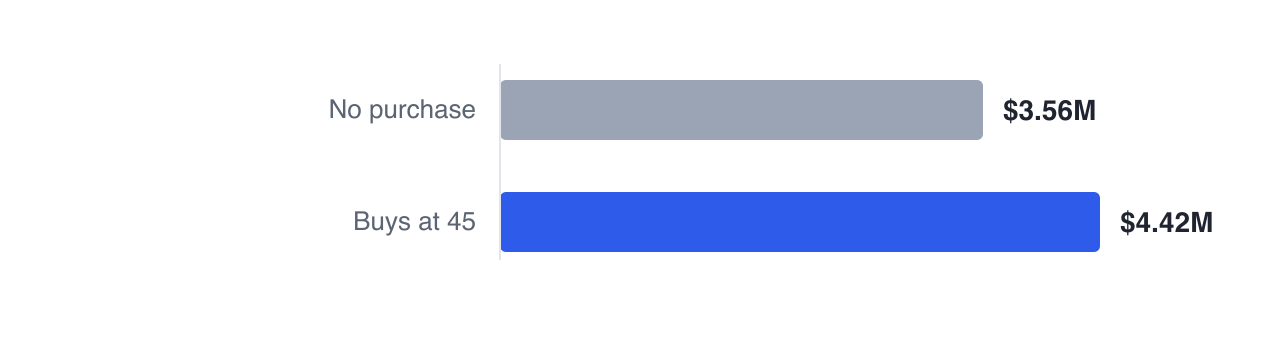
That distinction is the point. Home equity sits on the balance sheet and cannot be eaten. A later episode looks at what actually reaches a portfolio when that equity is eventually released.
One ordering detail
When both are available, spending the FHSA on the home before other sources tends to be the cleaner sequence, simply because a qualifying withdrawal is the account’s entire purpose and the account has a deadline anyway. The projection funds a property purchase that way by default, and the funding order is adjustable if a plan needs a different one.
A property-purchase goal takes the price, the down payment, an HBP amount per person and the mortgage terms, so the repayment schedule and the FHSA wind-down are both projected rather than assumed away.
Next: the employer match — the only guaranteed return in this entire series.
GlidePathEngine is an educational planning tool — not financial, investment, tax, or legal advice.