The first year of retirement
Retirement is usually described as an age. Operationally it is a year in which a dozen things change at once — income sources, tax treatment, benefits, insurance — several of them with deadlines attached.
Before the last paycheque
- Confirm what employer coverage ends and when. Group life and health insurance usually stop with employment, and any replacement is cheaper to arrange before you need it.
- Decide how a final payment — unused vacation, a bonus, severance — is received. It lands in a high-income year, and some of it may be transferable to an RRSP.
- Make the final year’s RRSP contribution while there is still earned income and a high marginal rate to deduct against.
- Get the pension election right if there is one. The survivor percentage and any bridge option are usually irrevocable.
Setting up the income
CPP and OAS both require applications, submitted months ahead. Neither is fully automatic, and a late application does not recover unlimited retroactive payments. If the plan defers either of them, the decision is to *not* apply yet — which means knowing the date you intend to.
Then the drawdown itself: which account funds this year’s spending, in what amount, and on what schedule. This is where the order from episodes 22 and 23 stops being theory. Setting up a regular monthly withdrawal that mimics a paycheque is worth doing simply because it makes the transition psychologically easier.
The year’s opportunities
A partial retirement year is often a low-income year, sometimes the lowest in decades. That makes it the cheapest year available for realising capital gains deliberately, or for beginning a registered drawdown ahead of the mandatory schedule.
It is also the year to convert enough RRSP to RRIF to create eligible pension income if you are 65, unlocking the pension income credit and splitting years before the conversion deadline requires anything.
Their staggered transition
Dan & Marie — 58 and 56, Alberta. Dan retires at 62 with a defined-benefit pension; Marie retires at 60. Their RRSPs are very different sizes, which matters later.
Marie retires at 60 and Dan at 62, so their household passes through a stretch with one salary and one retiree. That in-between period is not a footnote — it changes which accounts should fund spending and which person should be drawing at all.
By the year Dan turns 65 the household reports $65,091 of gross income, pays $3,854 of tax, and has $92,146 to spend. The tax bill is strikingly small relative to the spending — which is what a low-income transition year looks like.
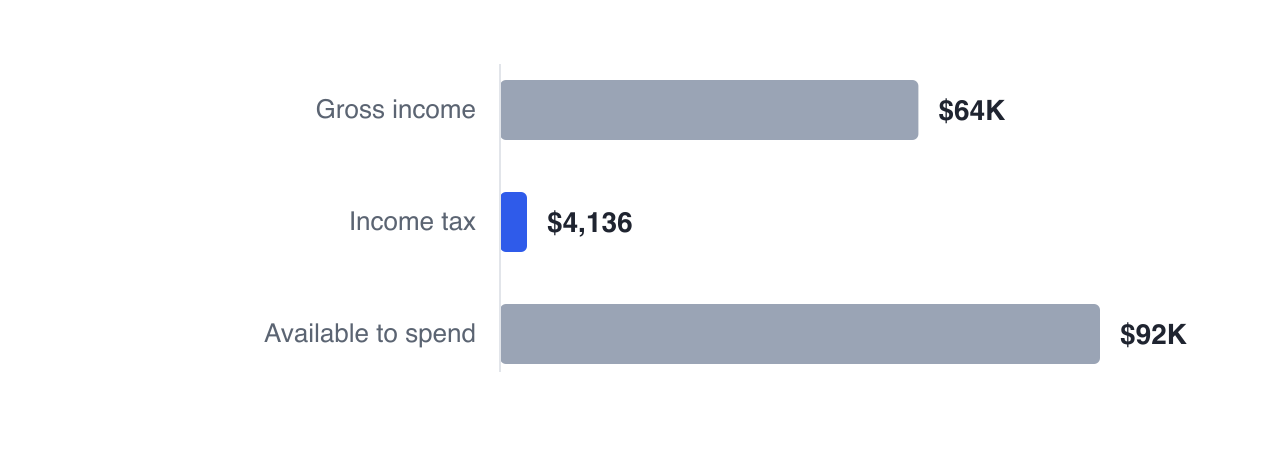
A tax bill that small next to that much spending is the signature of unused bracket space. Years like this are finite and they do not come back — the mandatory schedule fills the brackets soon enough.
The thing that is not financial
The transition from earning to spending is a genuine adjustment, and watching a balance fall for the first time after decades of watching it rise is harder than any spreadsheet suggests. A plan that says the withdrawals are sustainable is useful precisely because the first year does not feel that way.
Click the first retirement year in any chart and the drill-down shows exactly what the projection expects that year to contain — income sources, tax, and which accounts are funding the spending.
Next: withholding tax on RRSP withdrawals, and why it is not the tax you owe.
GlidePathEngine is an educational planning tool — not financial, investment, tax, or legal advice.