Where goal money actually comes from
Adding a goal to a plan raises a question the goal itself does not answer: which account pays for it? The answer changes the tax bill, the account balances afterwards, and sometimes whether the goal is affordable at all.
Savings first, by default
Unless told otherwise, a goal is funded from savings in the order the plan’s drawdown strategy implies. That is deliberate: for most goals in most plans, the expense is a call on accumulated capital rather than on the current paycheque.
The distinction matters for the true-cost arithmetic from the last episode. A goal paid from salary costs the plan almost nothing in compounding, because nothing was withdrawn and nothing stopped growing. A goal paid from a registered account costs the price, plus the tax, plus the growth.
Caps: an upper limit, not a target
Each funding source can carry a cap — either a percentage or a fixed amount. A cap says "take no more than this from here", so the source contributes the smaller of what is needed, what the cap allows, and what is actually available. Anything left over falls to the next source in the list.
The practical uses are specific. A percentage cap on salary stops a goal from consuming a whole paycheque. A dollar cap on the TFSA preserves a buffer you did not want spent. A cap of zero on an account excludes it entirely — which is a legitimate way to say "not from there".
Priya’s available sources
Priya — 54, Ontario, single. $118,000 salary, $410,000 in her RRSP and $88,000 in her TFSA, planning to retire at 63.
Before retirement Priya has her $118,000 salary as cash flow. After retirement she has $79,394 non-registered, $132,279 tax-free, and a registered balance heading toward $791,637. A goal at 60 and a goal at 68 face completely different menus.
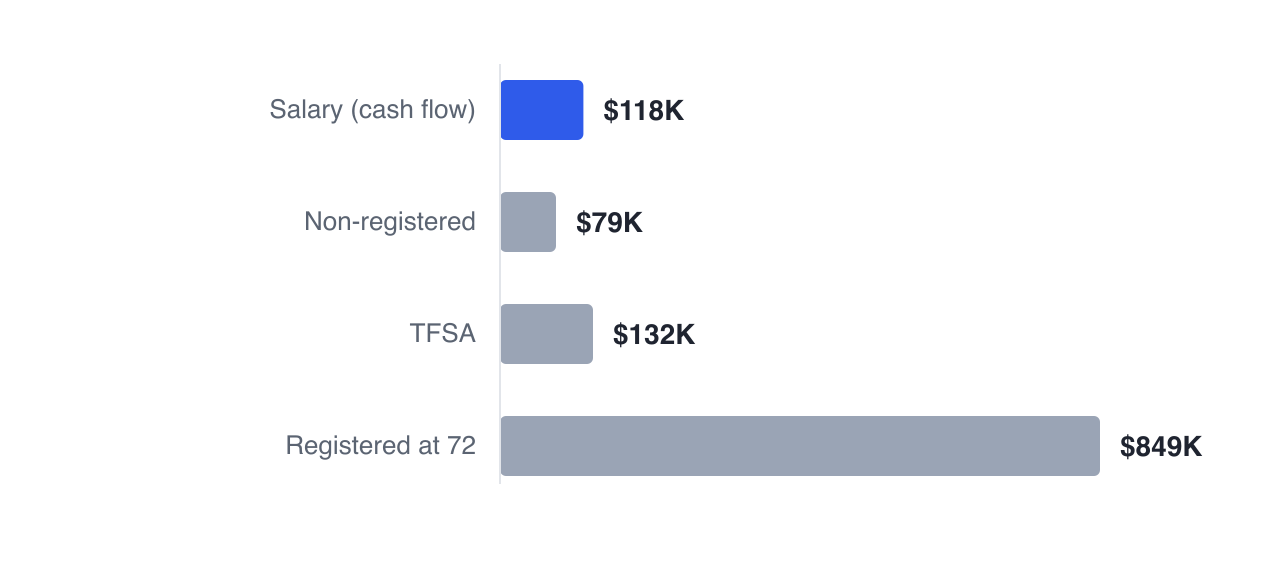
The registered bar is the largest and the most expensive to use — every dollar withdrawn is taxable, so funding a goal from it requires withdrawing more than the goal costs. The TFSA is the cheapest per dollar and the one a plan may be trying to preserve for the estate. Neither is automatically right.
When a goal cannot be funded
If the available sources cannot cover the goal, the shortfall is not silently absorbed. It accumulates as an unfunded amount, and a material shortfall pushes the goal’s status to off track. That is the honest outcome — a plan that quietly funded an unaffordable goal from nowhere would be a plan that had stopped modelling anything.
For couples there is a further decision: what share of the goal each person funds, and from which of their accounts. Splitting a large expense across two people’s registered accounts can keep both out of a higher bracket, which one person funding it alone would not.
Each goal takes an ordered list of funding sources with optional caps, per person — so the plan draws the money the way you would, rather than the way a default assumed.
Next: the meltdown strategy — paying tax early, on purpose.
GlidePathEngine is an educational planning tool — not financial, investment, tax, or legal advice.