Health-care costs: what’s actually covered
Canadians plan retirement health costs on an assumption that is half right: hospital and physician care is covered, comprehensively and without charge. Nearly everything else a retiree actually spends on health is somewhere else.
What is covered
Medically necessary hospital care and physician services, everywhere in Canada, with no charge at the point of use. That is the core of the system and it genuinely removes the catastrophic medical-cost risk that dominates retirement planning in some other countries.
Most provinces run a drug plan for seniors with a deductible and co-payments, often income-tested. That helps considerably and is not the same as full coverage — and the income-testing means a higher-income retiree pays more, which is another quiet interaction with the withdrawal decisions elsewhere in this series.
The transition nobody schedules
Employer health benefits usually end at retirement. For someone who has had drug, dental and vision coverage for thirty years, the first year of retirement is when those costs appear on the personal budget — often for the first time ever.
Some employers offer retiree benefits, and individual plans exist. Individual coverage for someone in their sixties is priced accordingly, and for predictable ongoing costs it is often cheaper to budget for the expense directly than to insure it.
Scale, against two different incomes
Ellen — 67, Nova Scotia, already retired on a modest income. Her CPP and OAS do most of the work and a small RRSP sits behind them.
Ordinary out-of-pocket health spending — drugs, dental, glasses, hearing — is a manageable line against a household spending $58,000 a year. Against Ellen’s $32,000 it is a materially larger share of the budget, and it is the same spending.
The category that dwarfs both is long-term care. A private facility can run to $85,000 a year or more — comparable to an entire household’s annual spending, and mostly outside what provincial coverage pays.
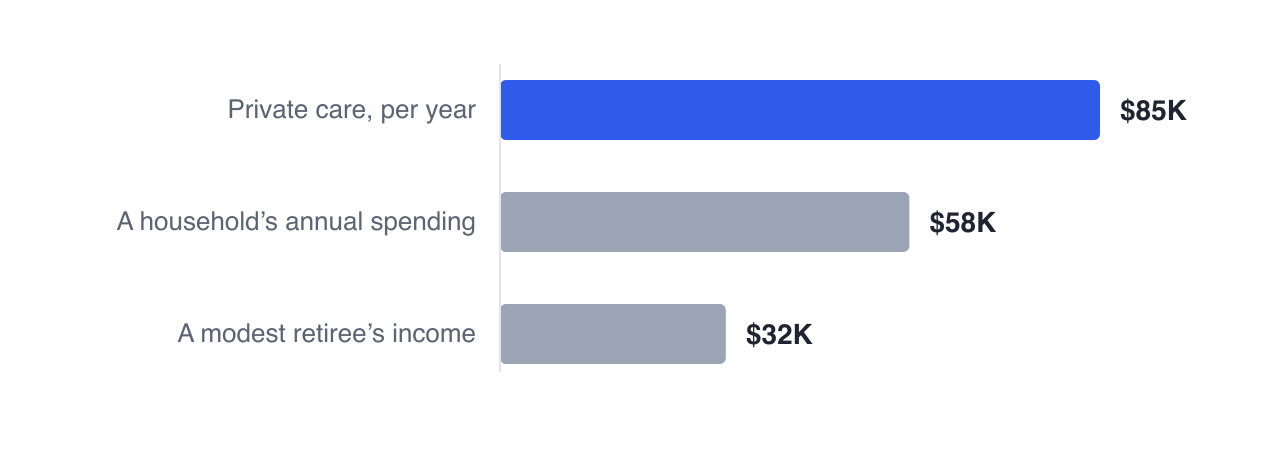
The proportions explain why episode 43 treated care as a plan-level shock while this episode treats drugs and dental as a budget line. They are different problems, and conflating them under "health costs" obscures both.
Two things worth doing
Find out what your province actually covers for seniors, including the drug plan’s deductible and whether it is income-tested. And find out whether your employer offers any retiree benefit — that question is answered before you retire or not at all.
Then treat ordinary health spending as part of the retirement budget rather than as an emergency, and treat long-term care as the separate, larger, probabilistic question it is.
One planning note that applies to both categories: costs in this area are billed to a person rather than a household, and several provincial programs are income-tested on the individual. So the same withdrawal decisions that drive tax and clawbacks elsewhere in this series also move what a drug plan charges — another reason the drawdown order reaches further than it looks.
Ordinary health costs belong in the spending target; a care window belongs in the care costs section with its own amount, duration and probability — so the projection treats them as the two different problems they are.
Next: applying for CPP and OAS — lead times, and the enrolment trap.
GlidePathEngine is an educational planning tool — not financial, investment, tax, or legal advice.