Helping adult children without wrecking your plan
Canada has no gift tax — you can give an adult child any amount and neither of you reports it. Which makes the mechanics simple and leaves the only real question: what does the gift cost the plan it came from?
The mechanics, briefly
A cash gift to an adult child is not income to them and not deductible to you. No form, no reporting, no tax. The attribution rules that apply to gifts to a spouse or a minor child do not apply to an adult one.
Now versus later
A gift given now arrives when it is most useful — a down payment, tuition, a business, a period of reduced income while raising children. The same money inherited at 60 arrives when the recipient is likely already established.
There is a tax argument too, from episode 84: money left in a registered account is collapsed into income at top rates in the final return. Money drawn during your lifetime is taxed at moderate rates across many years. Giving earlier is often the cheaper route for the same amount reaching the same person.
Against that, money given is gone. It cannot fund a care window at 85, and the irreversibility is the whole reason to size it against a projection rather than against a balance.
What a gift at 68 costs Priya
Priya — 54, Ontario, single. $118,000 salary, $410,000 in her RRSP and $88,000 in her TFSA, planning to retire at 63.
A $60,000 gift at 68 takes Priya’s plan from $399,597 to $325,683 — a cost of $73,914, meaningfully more than the gift, because the withdrawal is taxed and the money stops compounding.
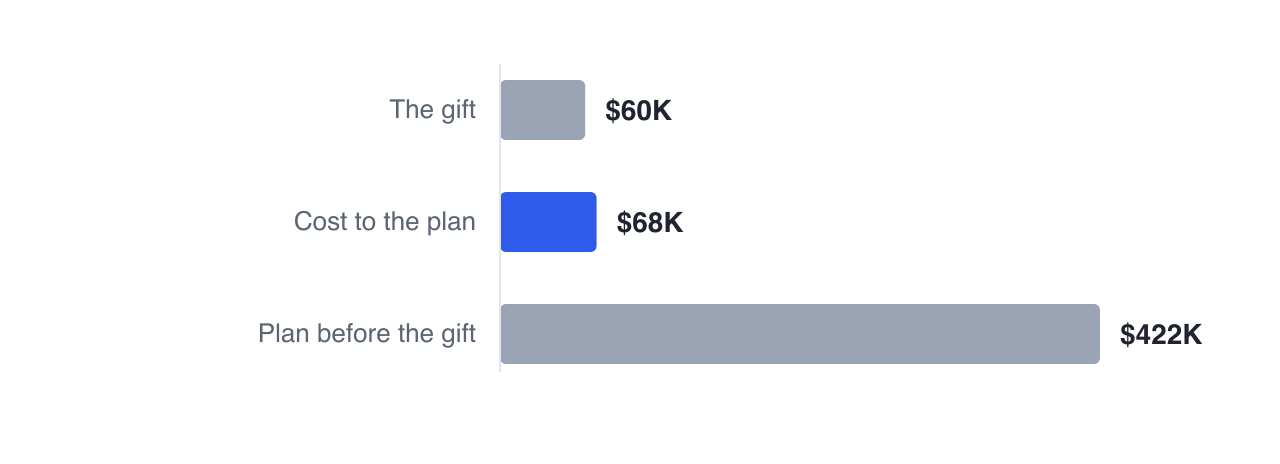
Her spending remains funded throughout and her simulated success rate — 75.7% before the gift — is what tells her whether the margin can absorb it. Affordable and free are different words, and the projection is what distinguishes them.
Loan or gift, decided in advance
A family loan is a legitimate structure and it needs to be documented as one — an amount, a rate, a schedule, in writing. Undocumented, it is a gift that one party believes was a loan, which is how family relationships and estates both get damaged.
The same clarity applies to fairness between children. An advance to one and an expectation of equalisation later needs to be written down somewhere the estate can find it, or the equal split in the will will not produce an equal outcome.
One structural alternative worth naming. Rather than a lump sum, some households provide ongoing support — covering a specific recurring cost for a defined period. That is easier to size against a plan, easier to stop, and shows up in a projection as a recurring goal rather than a one-time one, which reflects the commitment more accurately.
Add it as a one-time goal at the age you intend, and the projection funds it from your accounts — reporting what it costs the rest of the plan and whether the spending stays funded.
Next: the sandwich decade — two plans colliding at once.
GlidePathEngine is an educational planning tool — not financial, investment, tax, or legal advice.