Your home is not a retirement plan (but it is an asset)
For a great many Canadian households the house is worth more than everything else combined. It is also the asset that contributes nothing to the grocery bill, and confusing the two produces the most common false positive in retirement planning.
What a house is good at
It provides shelter without rent — which is a genuine, ongoing economic benefit and the main reason owning tends to help a retirement. It is exempt from tax on the gain as a principal residence. It is a forced savings mechanism, since mortgage payments build equity whether or not anyone was feeling disciplined. And it holds value against inflation over long periods.
It is also indivisible. A portfolio can fund a $40,000 year and then a $60,000 year. A house cannot be partially sold to cover a bad quarter.
Why readiness excludes it
This is the reason the readiness measure from episode 40 looks at income rather than net worth. A household with a valuable home and thin savings shows healthy net worth for decades while running out of spendable income long before the end. Counting the house would report that household as comfortable, which would be technically defensible and practically useless.
The house is not ignored, though — it appears in net worth and in the estate, which is exactly where it belongs. It is excluded from the income question because it does not answer the income question.
A house makes the number bigger and the income no larger
Sam — 41, British Columbia, self-employed through a corporation. No employer pension, no home yet, and a company that pays them both salary and dividends.
Sam buying a $620,000 home at 45 takes the plan’s final estate from $3,427,793 to $4,312,546 — $884,753 more. The plan looks substantially wealthier.
In that same final year the house alone is worth $936,551 — more than the whole improvement. Everything else in the estate, the part that can actually be spent, is smaller than it would have been without the house. And the income Sam retires on is no larger: both plans fund the same $72,000 a year.
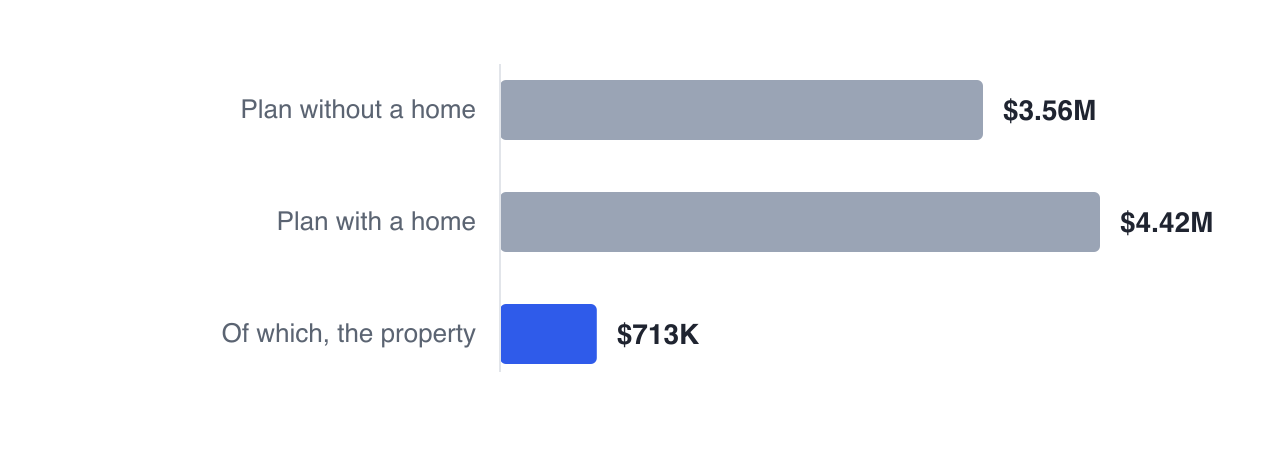
The ownership decision may well be right — the house is real wealth and it passes on tax-free as a principal residence — but none of it funds a year of retirement spending while Sam lives there. A bigger estate is not the same as a funded retirement.
The honest ways it does help
- No rent — the largest and most reliable benefit, delivered every year without any transaction at all.
- Downsizing — releases part of the equity, at a cost that a later episode prices properly.
- Borrowing against it — keeps you in the home and adds a debt that compounds, which is its own episode.
- The estate — the house passes on, tax-free on the gain as a principal residence, which is a real benefit to heirs and no benefit at all to you.
The real estate section holds property and its mortgage as their own line, so net worth includes them while the income and readiness figures stay honest about what actually funds spending.
Next: paying down the mortgage or contributing to the RRSP — comparing a certain return to an uncertain one.
GlidePathEngine is an educational planning tool — not financial, investment, tax, or legal advice.