How the advice engine measures a recommendation
Any tool can list generic suggestions. The harder question is what a suggestion is worth to you — and the only honest way to answer it is to run your plan twice and subtract.
The method
That is the same one-variable discipline as episode 70, applied automatically across every lever the engine can test — contribution room, benefit timing, drawdown configuration, contribution priority, spousal arrangements.
It also means the number is specific to you. The same suggestion is worth a great deal to one household and nothing to another, and a generic figure would be wrong for both.
Three kinds of recommendation
- Measured — a real counterfactual with a dollar figure. Only surfaces when the difference clears a meaningful threshold, so trivial suggestions do not crowd the list.
- Validation — something is wrong rather than suboptimal: an over-contribution, an invalid statutory age. No dollar figure, because the point is correctness.
- Advisory — a real consideration the projection does not model, such as asset location or tax-loss harvesting. Surfaced without a number, deliberately, because a figure from a model that does not simulate the mechanic would be fiction.
That third category is the one worth defending. It would be easy to attach a plausible estimate and much harder to justify it. An advisory item says "this is worth thinking about" and does not pretend to know how much.
Why the total is not the sum
Levers interact. Changing the drawdown order changes the balances that benefit timing is then applied to; contributing more changes the balance a meltdown would draw down. Adding up the individual figures would double-count those interactions.
So the headline total is its own counterfactual: the plan with all the applicable changes made together, measured once. It is usually less than the sum of the parts, and it is the number that would actually materialise.
Three measured levers
Priya — 54, Ontario, single. $118,000 salary, $410,000 in her RRSP and $88,000 in her TFSA, planning to retire at 63.
Against Priya’s $399,597 baseline: changing the drawdown order alone measures $547,069; contributing five more points of salary adds $85,443; carrying a two percent fee instead leaves $1,183.
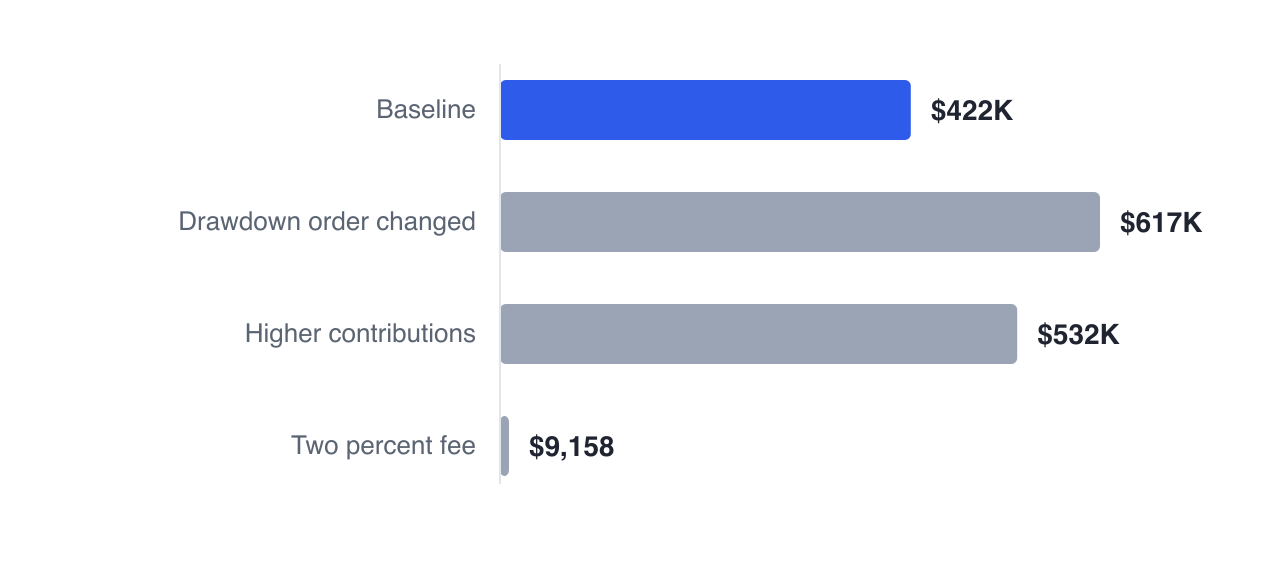
The fee bar illustrates the one category that is measured but not applicable. The engine can measure what a fee costs; it cannot remove a real fee from your life by toggling a setting. Measuring something and being able to fix it are different things, and the interface distinguishes them.
The one lever it will not touch
CPP and OAS timing is measured and reported directionally, and the engine will not write the ages into your plan. The two benefits interact through the clawbacks, so the ages are a joint decision rather than two independent ones, and they belong in the dedicated optimizer where you can see the whole grid.
That restraint is deliberate. A recommendation naming a precise age would look more confident than the underlying comparison supports, especially where the grid is flat across several ages.
The advice panel lists every recommendation with its measured value against your active objective, its effect on the other objective, and a total that accounts for the interactions.
Next: auto-solve — what it will and will not change.
GlidePathEngine is an educational planning tool — not financial, investment, tax, or legal advice.