Contribution room: how RRSP room is created
RRSP room is the one number in your financial life that the government calculates for you, tells you once a year, and then expects you to track. It is generated by a formula with three moving parts, and one of them surprises almost everyone with a workplace pension.
The formula
New room for a year is 18% of the previous year's earned income, capped at an annual dollar maximum — $33,810 for the current rules year — and then reduced by your pension adjustment, if you have one.
Three things follow from that, and each one catches people out.
One: it is last year’s income, not this year’s
The room you can use this year was generated by what you earned last year. A raise does not create room until the following year, and the year you stop working still generates room for the year after — the last one you will get.
Two: "earned income" is narrower than "income"
Earned income means employment income, net self-employment income, net rental income, and a few less common items. It does not include investment income, capital gains, most pension income, or withdrawals from registered accounts.
The practical consequence is that a retiree living on investments and CPP generates no new RRSP room at all, regardless of how much income they report. Room generation is tied to working, not to earning.
Three: a pension already used some of it
If you belong to a workplace pension, the pension adjustment reduces your RRSP room by roughly the value of the benefit you accrued that year. The logic is deliberate: the tax system gives everyone a similar total amount of tax-sheltered retirement saving, whether it arrives through a pension or through an RRSP you fill yourself.
For someone in a generous defined-benefit plan, the pension adjustment can consume nearly all of the year’s room. That is not a penalty — it reflects that the pension is doing the work the RRSP would otherwise do — but it does mean the "18% of income" figure is an upper bound rather than an expectation.
Which limit binds for Priya
Priya — 54, Ontario, single. $118,000 salary, $410,000 in her RRSP and $88,000 in her TFSA, planning to retire at 63.
Priya earns $118,000 and has no workplace pension, so no pension adjustment applies. Her new room is 18% of that — $21,240 — which sits comfortably below the annual ceiling of $33,810.
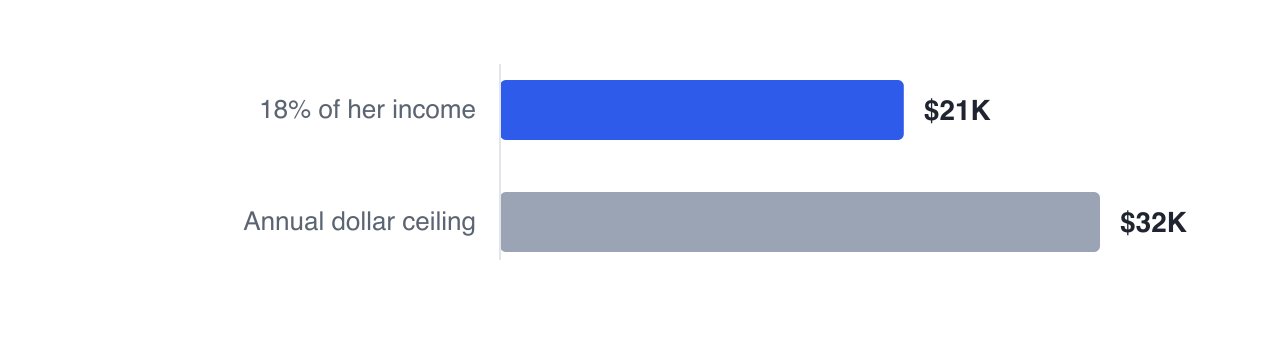
The crossover is worth knowing: the cap only becomes the binding constraint above about $187,833 of earned income. Below that, every extra dollar earned creates 18% more room next year.
Unused room carries forward — which is the good news and the trap
Room you do not use is not lost. It accumulates indefinitely, which is why so many people discover a five- or six-figure "deduction limit" on their notice of assessment and assume something has gone wrong. Nothing has: it is every year they did not contribute, added up.
The carry-forward is genuinely valuable, because it lets you defer a contribution to a year when your marginal rate is higher — the rate gap from episode 4, used deliberately. A contribution made in a low-income year and deducted in a high-income one is a common and entirely legitimate move, since contributing and deducting are separate steps.
Enter your deduction limit from your Notice of Assessment in the accounts section. The projection carries it forward year by year, warns you before a planned contribution exceeds it, and reports what is left in every year of the plan.
Next: TFSA room, which works on completely different principles — and the recontribution mistake that costs Canadians penalties every year.
GlidePathEngine is an educational planning tool — not financial, investment, tax, or legal advice.