Leaving an estate on purpose rather than by accident
Run almost any retirement plan and it ends with money left over. That outcome is treated as reassurance, and it is also a decision: that money was not spent, and the decision not to spend it was made by default rather than by anyone.
Why plans over-save by default
Planning conservatively is sensible, and it accumulates. A cautious return assumption, a long horizon, a spending estimate with margin, and a reluctance to draw down capital each push the same direction. Individually reasonable, collectively they produce a plan whose most likely outcome is dying with a substantial unspent balance.
The asymmetry from episode 39 is what drives it. Running out of money is catastrophic and ending with too much is merely inefficient, so every uncertain input gets rounded toward safety. That is defensible. It is also worth knowing the size of what it costs.
Why it is not just an accounting question
Money given during your lifetime can arrive when it is most useful — a down payment, a tuition bill, a career change — rather than when the recipient is in their sixties and already established. The same dollars have different value at different times.
There is also a tax argument. An unspent registered balance is collapsed into income in the final return at top rates, as episode 84 showed. Money spent or given during your lifetime is drawn at moderate rates across many years. The intended-estate route is usually more expensive than the intended-spending route on the same amount.
And a real argument the other way
A large terminal balance is also insurance against everything the plan did not model — care costs, an unusually long life, a health event, supporting someone unexpectedly. Held deliberately for that reason it is not inefficiency, it is a reserve.
The distinction between a reserve and an accident is whether you named it. Both look identical in the projection.
What their plan does not spend
Dan & Marie — 58 and 56, Alberta. Dan retires at 62 with a defined-benefit pension; Marie retires at 60. Their RRSPs are very different sizes, which matters later.
Dan and Marie spend $96,000 a year and their net worth rises through almost the whole retirement — from $1,112,794 at the start to a peak of $1,903,260, ending at $1,747,650. They never draw the pile down at all.
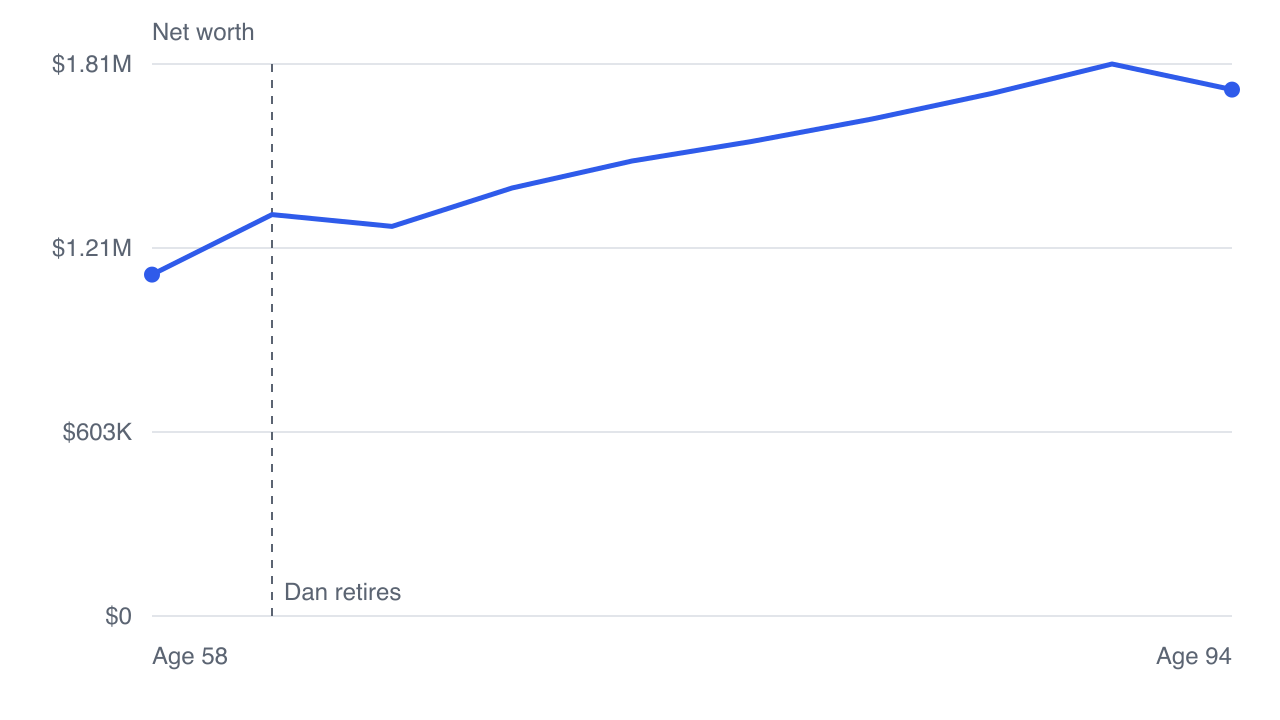
That shape is the episode’s whole point. It is not a plan that spends its savings — it is a plan whose forced income exceeds its spending every single year, accumulating throughout. Optimising it for the estate takes it to $1,968,400; optimising it for spending would mean spending more, which nobody has asked it to do.
The question worth answering
How much do you intend to leave, and to whom? A number, even a rough one, turns the terminal balance from a residual into a target — and a target can be tested against, planned for, and given away earlier if it is being exceeded.
It is also the only way to know whether the plan is over-saving. Without a stated intention there is nothing to compare the outcome to.
The objective toggle scores your plan for the largest estate or the most spending, and reports how each recommendation affects both — so a strategy that helps one and hurts the other is visible rather than hidden.
Next: charitable giving — donating securities rather than cash.
GlidePathEngine is an educational planning tool — not financial, investment, tax, or legal advice.