Level depletion versus bracket filling
This one is a note from the engine room. The obvious way to size a deliberate withdrawal is to fill your current tax bracket each year. We built that, watched what it did over thirty years, and removed it.
What bracket filling does
The rule is appealing: each year, withdraw enough registered money to reach the top of your current bracket and no further. Never pay a higher rate than you have to. It feels disciplined, and it is easy to explain.
The failure is worse than doing nothing, because it feels like a strategy. Each individual year looks well-managed. The aggregate is a balance that balloons and then produces exactly the forced-income spike the exercise was meant to prevent.
What replaced it
Level depletion starts from the other end. Given a balance, an expected return and a horizon, it computes the withdrawal that would deplete the account smoothly across that horizon — the same arithmetic that prices an annuity payment.
The result is a withdrawal sized by the problem rather than by a tax threshold. A large balance produces a large withdrawal because a large balance is the thing that needs draining. Tax is then whatever it is — considered, but not in charge of the schedule.
What level depletion does to the forced minimum
Dan & Marie — 58 and 56, Alberta. Dan retires at 62 with a defined-benefit pension; Marie retires at 60. Their RRSPs are very different sizes, which matters later.
Dan’s registered balance reaches $867,700 at 71 under the default plan. With level-depletion withdrawals running through the retirement years, it is $433,604 at 72 instead.
The consequence shows up in the mandatory schedule: the required withdrawal at 80 falls from $45,657 to $18,875 — less than half. Forced income in his eighties has been cut by drawing deliberately in his sixties.
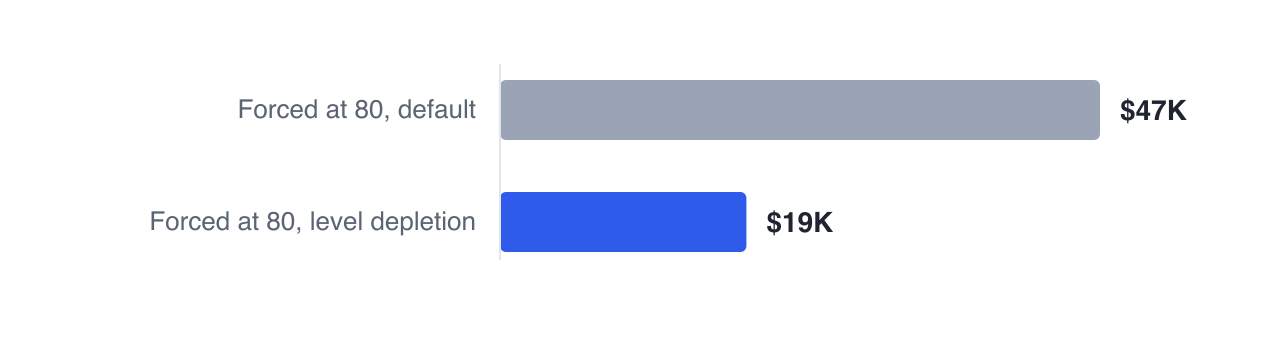
That reduction is the real product of the strategy. Not a smaller tax bill in any single year, but a decade of eighties in which the household chooses its own income rather than having a table choose it.
The general lesson
A drawdown rule has to be anchored to the quantity it is trying to control. Bracket filling is anchored to a tax threshold, which has nothing to do with how much money there is or how long it has to last. Level depletion is anchored to both.
The same test is worth applying to any withdrawal rule you encounter, including the famous percentage-based ones. Ask what the rule is anchored to, and whether that thing is actually related to the outcome you want.
Two practical caveats. The horizon the calculation uses is a life expectancy, which is an assumption rather than a fact — a longer horizon produces a gentler withdrawal and a larger surviving balance. And the withdrawal is recomputed each year against the actual balance, so a poor market year automatically reduces the following year’s amount rather than draining a depleted account at a fixed rate.
The strategy comparison runs your plan under each configuration and reports lifetime tax and what is left, so the sizing question is settled on your balance and your horizon rather than on a rule of thumb.
Next: harvesting gains and losses — two opposite moves, each right in different years.
GlidePathEngine is an educational planning tool — not financial, investment, tax, or legal advice.