LIF maximums: the ceiling that varies by province
Retirement accounts generally worry about you taking too little. A life income fund is the one that also worries about you taking too much — and the rule about how much is too much depends on which province regulated the pension the money came from.
Why a maximum exists at all
Pension legislation aims to make sure pension money lasts a lifetime. A minimum withdrawal serves the tax system’s interest in collecting deferred tax; a maximum serves the pension system’s interest in the money still being there at 90. The two rules come from different places and are aimed at different risks.
The shape of the ceiling
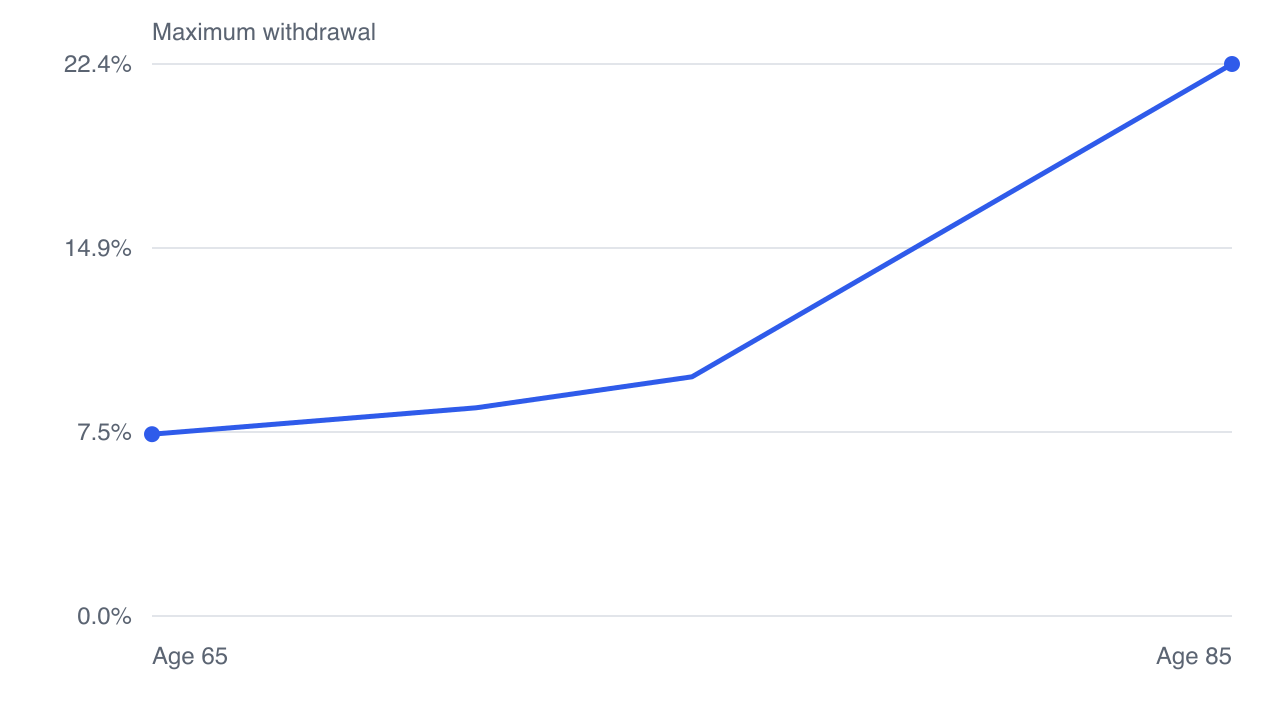
The maximum rises steeply with age. Under the federal and Ontario schedule it is about 7.4% at 65, 8.5% at 71, 9.7% at 75 and 22.4% at 85 — steeper than the minimum schedule beneath it, which is 5.8% and 8.5% at the same two ages.
So the band widens as you age. It is narrowest in your sixties — exactly when a retiree might most want the flexibility to draw more heavily, whether to bridge to CPP or to deliberately reduce a registered balance before the mandatory schedule arrives.
Three schedules, not one
- The federal and Ontario-style schedule, which most jurisdictions follow closely.
- Variants used by some provinces, including Manitoba and Nova Scotia, with their own percentages.
- Quebec, which does not impose a maximum on a LIF holder past the earliest withdrawal age at all — the account behaves much more like a RRIF.
Which one applies is set by the pension jurisdiction, not by where you now live. Two neighbours in the same town with identical balances can face different ceilings because their pensions were registered in different provinces.
What the band does to a strategy
Dan & Marie — 58 and 56, Alberta. Dan retires at 62 with a defined-benefit pension; Marie retires at 60. Their RRSPs are very different sizes, which matters later.
Consider a household that has decided to draw registered money down early — the strategy from episodes 22 and 23. Applied to an RRSP, the only limit is the tax consequence. Applied to a LIF, there is a hard ceiling, and in the years before 70 that ceiling is low.
The projection handles this by drawing the mandatory minimum out first regardless of strategy, then treating the remaining room up to the maximum as available — and sending any shortfall to other accounts. That is the same thing a careful retiree does manually, and it is the reason a locked-in balance changes the order the rest of the plan is drawn in.
One route through the ceiling
Several jurisdictions permit a one-time partial transfer out of a LIF into an RRSP or RRIF, often at a specific age and usually capped at a fraction of the balance. Money that makes that trip loses the ceiling permanently. Whether the option exists, and on what terms, depends entirely on the pension jurisdiction — which makes it worth checking rather than assuming in either direction.
The projection applies your jurisdiction’s minimum and maximum schedules year by year, so the ledger shows what a LIF can actually contribute to spending in each year rather than treating it as freely available.
Next: investment fees — the 2% that quietly costs a house.
GlidePathEngine is an educational planning tool — not financial, investment, tax, or legal advice.