Locked-in accounts: LIRA, LIF, and why they differ
Leave a job with a pension and you may be offered the commuted value. Take it, and the money is unmistakably yours — sitting in an account you are not allowed to withdraw from. The restriction is not a mistake; it is the pension following the money.
How money gets locked in
A LIRA — a locked-in retirement account, called a locked-in RRSP in some jurisdictions — holds the transferred value of a pension entitlement. Pension law requires that money to provide retirement income rather than be spent as a lump sum, and the restriction travels with it into the account.
Otherwise a LIRA behaves like an RRSP. It grows tax-deferred, holds the same kinds of investments, and can be transferred between institutions. You simply cannot take money out of it.
Converting to a LIF
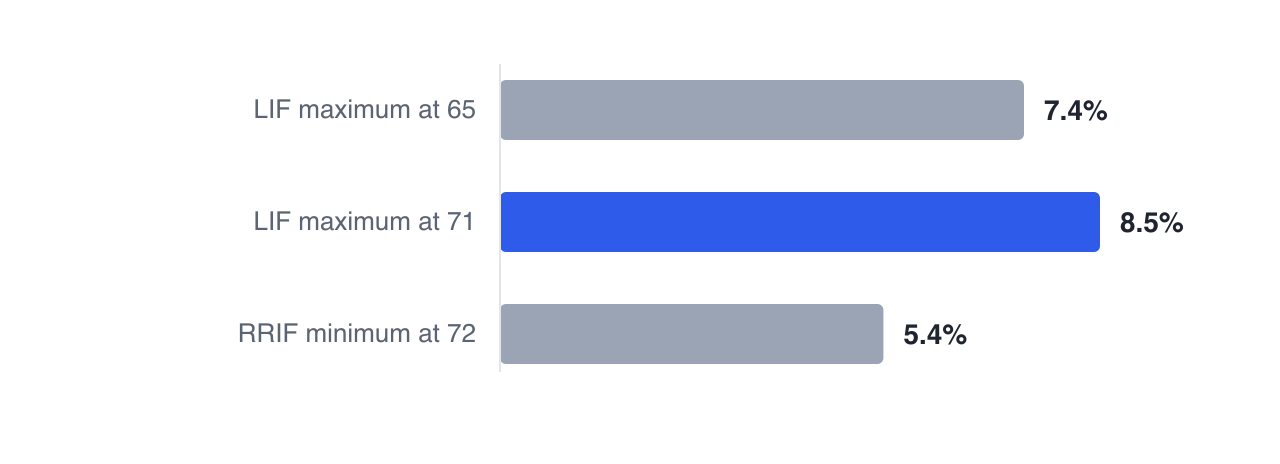
The maximum is the feature with no equivalent anywhere else in Canadian retirement accounts, and it is the one that surprises people. A LIF holder facing an unexpected expense cannot simply take more. At 65 the ceiling is around 7.4% of the balance, and by 71 it is about 8.5% — against a RRIF minimum of 5.4% the following year.
Conversion can happen from around 55 in most jurisdictions — earlier in a couple of provinces — and must happen by the same age 71 deadline that applies to an RRSP.
Which rules apply to you
This is the part that makes locked-in accounts genuinely confusing. The rules come from the pension jurisdiction — the province or the federal regime the original plan was registered under — not from where you live now. Someone who earned a pension in one province and retired to another is governed by the first.
Most jurisdictions offer some form of unlocking: a one-time partial transfer to an RRSP at a given age, a small-balance provision, or an unlocking on financial hardship or shortened life expectancy. What is available, and when, varies enough that the jurisdiction is the first thing to establish.
Why a LIF is drawn differently
Dan & Marie — 58 and 56, Alberta. Dan retires at 62 with a defined-benefit pension; Marie retires at 60. Their RRSPs are very different sizes, which matters later.
A household with locked-in money has less freedom in the drawdown decisions from episodes 22 and 23. The mandatory minimum comes out whatever strategy is chosen, and the maximum caps how fast the account can be deliberately drawn down — so a meltdown strategy simply cannot reach a LIF the way it reaches an RRSP.
The practical consequence is ordering. Because the LIF has a ceiling and the RRSP does not, the flexible account is the RRSP — which is worth knowing before committing to a drawdown sequence that assumed both were equally reachable.
What is the same
Tax treatment, estate treatment and spousal rollover all work as they do for an RRSP or RRIF. Withdrawals are fully taxable, the balance rolls to a surviving spouse, and whatever remains at the second death is income in the terminal return. The lock is about access, not about tax.
The accounts section takes a LIRA balance and a conversion age, and the projection applies your jurisdiction’s minimum and maximum schedules — so the constraint appears in the plan rather than as a surprise later.
Next: the LIF maximum in detail — a ceiling that changes depending on where the pension came from.
GlidePathEngine is an educational planning tool — not financial, investment, tax, or legal advice.