Long-term care: the late-life cost that breaks plans
Most retirement plans implicitly assume spending drifts gently downward with age. Care costs do the opposite — they arrive late, all at once, in the years when there is no capacity left to earn or adjust.
What is actually covered
Provincial health systems cover medical care. They do not, in general, cover the accommodation and personal support components of long-term care in the way people assume. Subsidised beds exist and are means-tested, waitlisted, and not distributed evenly; private and semi-private options are paid privately.
Home care sits in a similar gap. Some hours are publicly funded; the number of hours a person actually needs to stay at home is frequently larger, and the difference is paid privately by the hour.
Why a portfolio absorbs it badly
A shock early in retirement lands while there is still room to adjust — spend a little less for a few years, work a year longer, let the markets make some of it back. A shock at 85 does not: the money leaves, and the plan has no levers left to pull.
One thing does soften it. Care costs count as medical expenses, so the medical expense tax credit hands part of the bill back in the years it is paid. It is real money and it is not most of the cost.
There is one genuine offset: care spending often replaces other spending rather than adding to it. Someone in a facility is not also running a household. Modelling the full cost on top of unchanged spending overstates it, and modelling nothing at all understates it considerably more.
A three-year window at 85
Dan & Marie — 58 and 56, Alberta. Dan retires at 62 with a defined-benefit pension; Marie retires at 60. Their RRSPs are very different sizes, which matters later.
Adding a $85,000-a-year care window for three years from 85 to Dan and Marie’s plan — $255,000 in total, in today’s dollars — takes their plan from $1,747,650 to $1,476,531. That is a fall of $271,120: more than the window’s face value, even after the medical expense credit cuts their tax by more than half in each care year, because every dollar drawn at 85 would otherwise have kept growing to the end of the plan.
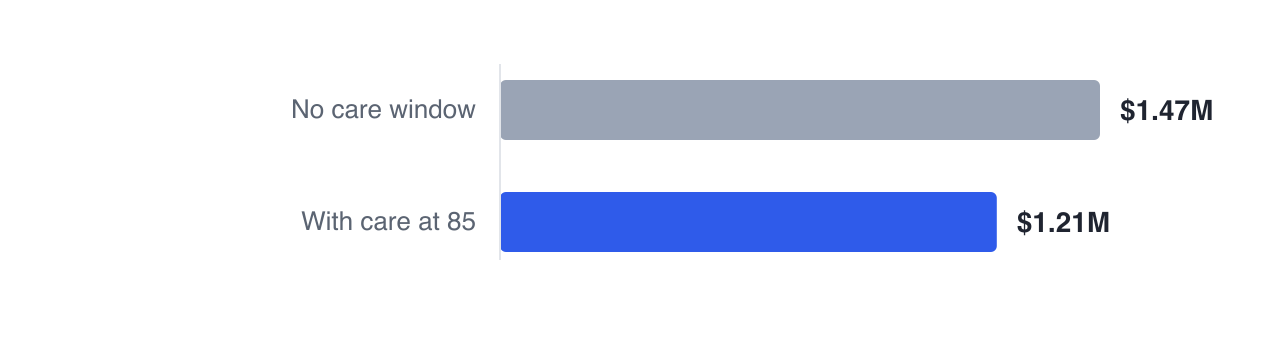
Their plan absorbs it — the estate shrinks and the spending is still funded. A thinner plan does not: adding a $75,000-a-year window to Priya’s plan, given a fifty-fifty chance of happening at all, moves her simulated success rate from 75.7% to 65.5%, which is the difference between a comfortable margin and a real one.
The options for covering it
- Self-insure from the portfolio, which is what most households do implicitly. It works if the plan has the margin, and the point of modelling it is to find out.
- Home equity, released by selling or borrowing — often the largest single asset available, and the one most likely to be freed up at exactly this stage of life.
- Long-term care insurance, which exists in Canada, is not widely held, and prices the risk explicitly. Whether the premium is worth it depends on the margin the plan already has.
Because duration and probability are both genuinely uncertain, the useful approach is to model a window with an assigned likelihood and see how often the plan survives it, rather than to pick one scenario and treat it as the answer.
The care costs section takes an annual amount, a start age, a duration and a probability — the deterministic projection applies it in full, and the simulation includes it at the likelihood you set.
Next: life insurance — how much, how long, and when it stops being needed.
GlidePathEngine is an educational planning tool — not financial, investment, tax, or legal advice.