Longevity: planning to 90 versus 100
Life expectancy is an average, and averages have a top half. Planning a retirement to the average is planning to be fine in about half of the futures you might actually have — which is not the standard anyone applies to anything else in their financial life.
Two numbers that get confused
Life expectancy at birth is the figure quoted in the news, and it is dragged down by deaths at every earlier age. Life expectancy conditional on already being 65 is higher — sometimes by several years — because you have already survived everything that happens before 65. The second is the relevant one for retirement planning, and it is rarely the one people have in mind.
Why the error is asymmetric
Plan too long and the consequence is an estate larger than intended — money that could have been spent or given away. Plan too short and the consequence is running out of money at 92, with no remaining capacity to earn, adjust or recover. The two outcomes are not equally bad, which is why the standard practice is to plan past the average rather than to it.
The costs are also unevenly distributed. Someone with substantial indexed income — a good pension, full CPP and OAS — has a floor that lasts as long as they do, so longevity is less threatening. Someone funding retirement almost entirely from a portfolio faces the full force of the extra decade.
What the extra decade costs Priya
Priya — 54, Ontario, single. $118,000 salary, $410,000 in her RRSP and $88,000 in her TFSA, planning to retire at 63.
Priya’s baseline plan runs to 90 and ends at $399,597 of net estate, after the final tax bill. Extending the same plan — same spending, same savings, same everything — to 100 leaves $294,564.
The path there is the informative part. Her net worth — before any final tax — is $515,406 at 90, $412,418 at 95 and $308,330 at 100, and every one of the extra ten years still meets her income target. The plan survives the extra decade, thinner. It does not fall apart, and it does not sail through untouched.
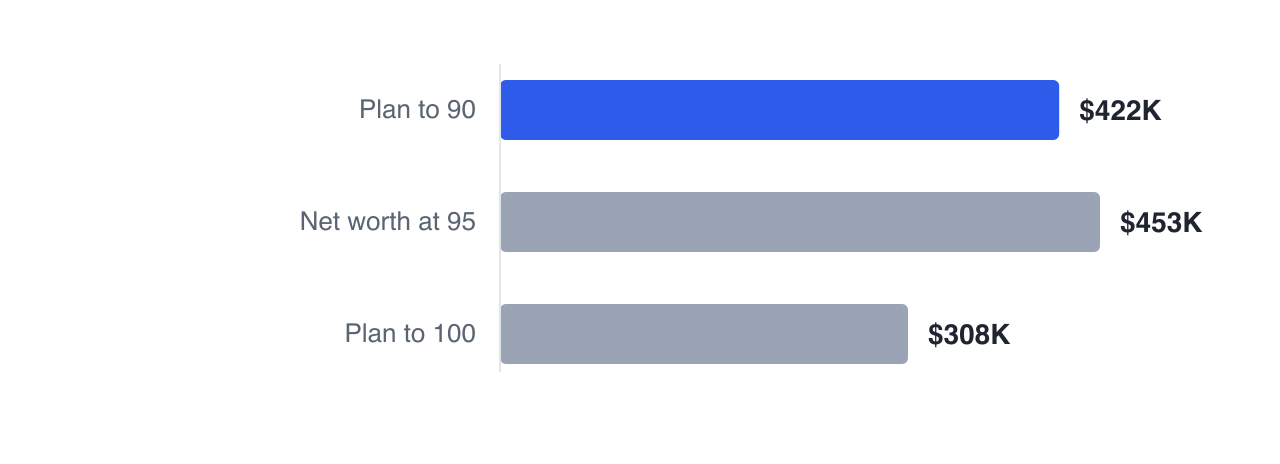
That is a useful outcome to know in advance. A plan that thins gracefully has longevity risk it can absorb; a plan that hits zero at 94 has longevity risk it cannot, and the response to each is different.
The instruments that address it
Only a few things genuinely transfer longevity risk rather than merely funding it. Deferring CPP is the cheapest and most accessible: the increase is permanent, indexed and lasts exactly as long as you do. A life annuity does the same thing commercially. Both convert a pile of money into an income that cannot be outlived, which is precisely the risk in question.
Everything else — saving more, spending less, investing differently — makes the pile bigger without changing the fact that it is finite.
Change the life expectancy in the household section and the projection re-runs live, so you can see whether the extra decade thins your plan or breaks it before deciding how much of it to fund.
Next: the retirement readiness gauge — what it measures and what it deliberately ignores.
GlidePathEngine is an educational planning tool — not financial, investment, tax, or legal advice.