Modelling a big purchase without wrecking the plan
A large purchase in retirement has two prices: the one on the invoice, and the one your plan pays over the following twenty-five years. The second is always larger, and it is the one nobody quotes.
Why the invoice understates it
Money spent from a portfolio stops compounding on the day it leaves. It also usually has to be withdrawn from somewhere taxable, so funding a purchase means withdrawing more than the purchase price. Both effects sit on top of the sticker.
The two ways to size it
The wrong way is to compare the purchase against the current balance — "I have enough, so I can afford it". A balance is not a budget; it is a machine for producing income for thirty years, and removing part of it reduces the output for all of them.
The right way is to run the plan twice, with and without, and look at the difference in the outcome you actually care about — what is left at the end, or whether the spending is still funded every year. That converts an abstract "can I afford it" into a specific number you can weigh against the thing you are buying.
A $60,000 purchase at 68
Priya — 54, Ontario, single. $118,000 salary, $410,000 in her RRSP and $88,000 in her TFSA, planning to retire at 63.
Adding a one-time $60,000 expense at 68 to Priya’s plan takes her from $399,597 to $325,683 — a cost of $73,914.
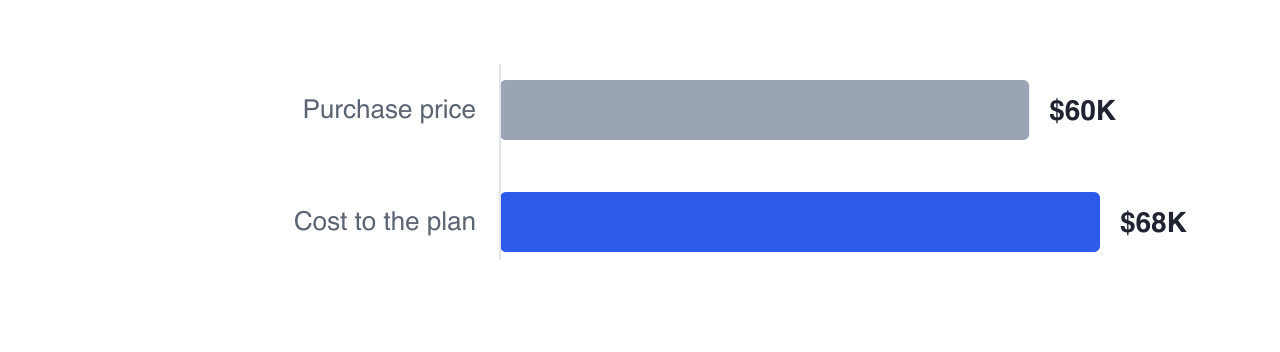
The cost exceeds the price by a meaningful margin, and the gap is entirely tax and forgone growth. Note also what did not happen: her readiness did not move — every retirement year still clears the bar. The purchase was affordable — it simply was not free, and the difference between those two statements is the whole exercise.
Flexible versus mandatory
Some purchases have to happen on a date — a roof, a vehicle that has failed. Others are genuinely discretionary and could wait a year or scale down. Marking which is which matters, because a flexible expense can be reduced in a poor market year while a mandatory one cannot, and a plan that knows the difference behaves differently under stress.
That is why a goal in this projection carries a flexibility setting rather than just an amount. In a bad year the flexible ones scale back and the mandatory ones do not, which is what a real household does.
The timing is often a larger lever than the size. The same $60,000 costs Priya’s plan $112,189 at 58, while she is still working: it comes out of her TFSA, tax-free that day, and takes ten more years of sheltered growth with it. It costs $73,914 at 68, in a low-income year before her RRIF minimums, and $87,746 at 75, on top of those minimums. The cheapest year is the quiet one.
The goals section takes a one-time expense with a target age and a flexibility setting, and the projection funds it from savings — so the cost to the rest of the plan is measured rather than estimated.
Next: where the money for that goal actually comes from, and how to control it.
GlidePathEngine is an educational planning tool — not financial, investment, tax, or legal advice.