Mortgage prepayment versus RRSP contribution
Every dollar used to prepay a mortgage earns exactly the mortgage rate, guaranteed, tax-free and immediately. There is no investment with that combination of properties, which makes this comparison harder than it first looks.
What prepayment actually returns
That last property matters more than it seems. In a non-registered account you would need a pre-tax return well above 5% to keep 5% after tax. Prepayment skips the comparison entirely — nothing is reported, so nothing is taxed.
What the RRSP side brings
An RRSP contribution gets an immediate deduction at your marginal rate, then grows sheltered, then is taxed on withdrawal. Its value is the spread between the two rates plus decades of tax-free compounding — the whole subject of episode 4.
It also has properties prepayment lacks. Contribution room carries forward but a high-rate year does not — the deduction is worth most at your peak marginal rate, and that peak may not last. And an RRSP is liquid in an emergency, at a tax cost. Home equity is not.
The comparison that actually applies
- Compare the mortgage rate against your expected after-tax return on the alternative — not against a hoped-for market return.
- Adjust for certainty. A guaranteed return deserves a premium over an uncertain one of the same size; how large a premium is a judgement about your own tolerance.
- Check the rate gap from episode 4. A large gap between your rate today and your rate at withdrawal is a strong argument for the contribution that prepayment cannot match.
- Consider sequencing. The deduction can often be used to fund the prepayment — contribute, then direct the refund at the mortgage. That is not a compromise so much as using both mechanisms on the same dollar.
What the gap is worth to Priya
Priya — 54, Ontario, single. $118,000 salary, $410,000 in her RRSP and $88,000 in her TFSA, planning to retire at 63.
Priya deducts at 37.2% today and her plan withdraws at 19.1% at 70 — a wide spread, which is the RRSP side of this argument at close to its strongest.
And directing five more points of salary into the RRSP each year adds $85,443 to a plan that otherwise ends at $399,597. That is what the contribution route produces over her horizon, before any comparison to a mortgage rate.
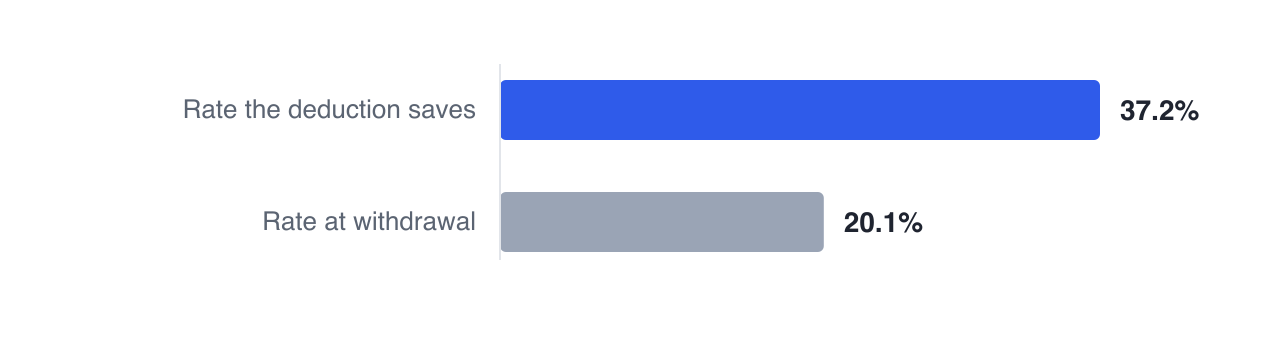
Someone whose rate today is close to their rate at withdrawal has a much weaker RRSP case, and the certain return on prepayment competes far better. The comparison genuinely reverses between two households with the same mortgage.
The part that is not arithmetic
Some households value being debt-free in a way no spreadsheet captures, and that is a legitimate input rather than an error to be corrected. Entering retirement with no mortgage lowers required income, which lowers required withdrawals, which lowers tax and clawback exposure — a chain of effects that shows up in a projection even when the pure rate comparison was close.
A mortgage is entered on the property it belongs to, in the real estate section, with its rate and amortisation — so the projection shows the balance falling year by year next to the accounts, and what entering retirement with or without it does to required income.
Next: the RESP and the twenty percent most families leave on the table.
GlidePathEngine is an educational planning tool — not financial, investment, tax, or legal advice.