Moving provinces in retirement
Moving provinces changes your tax rate, and not everything about your plan moves with you. A few things are permanently governed by where they started — which is the part worth knowing before the moving truck is booked.
Residency is decided on one date
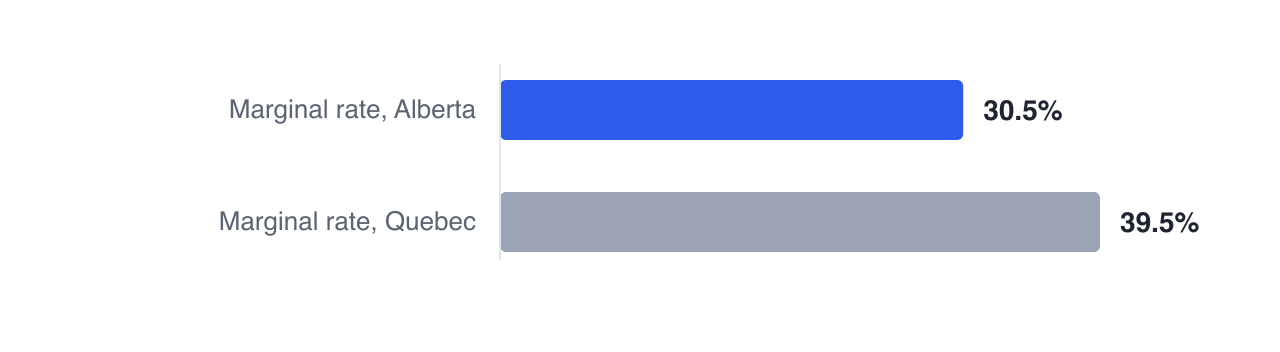
That makes the timing of a move a genuine tax decision when the two provinces differ materially — and at $80,000 of income the spread runs from 30.5% to 36.1%. Residency means where you actually live, not where a mailing address is; the test looks at where your home, family and life are.
What travels with you
- Every registered account — RRSP, RRIF, TFSA, FHSA, RESP. These are federal, and moving changes nothing about them.
- CPP, OAS and GIS, in full. Federal, identical everywhere, unaffected by a move.
- Contribution room of every kind. Also federal.
- A defined benefit pension, which pays what it pays wherever you live.
What does not
The important one is locked-in money. A LIRA or LIF is governed by the pension jurisdiction of the original plan, permanently. Moving does not change the minimum, the maximum — roughly 8.5% of the balance at 71 under the federal and Ontario schedule — or the unlocking provisions available to you. Someone who earned a pension in one province and retires to another is still governed by the first.
Provincial health coverage also has a waiting period, commonly up to three months, during which the previous province generally continues to cover you. Drug plan coverage, formularies and long-term care subsidies differ substantially and start fresh in the new province — a difference that can matter more in later retirement than the income tax does.
And a will is a provincial document. It does not become invalid on crossing a border, but formalities, spousal rights and intestacy rules differ, so a will drafted in one province deserves a review in the new one.
A household with locked-in money
Dan & Marie — 58 and 56, Alberta. Dan retires at 62 with a defined-benefit pension; Marie retires at 60. Their RRSPs are very different sizes, which matters later.
Dan and Marie live in Alberta, where the marginal rate on $80,000 is 30.5%. Moving would change their income tax, their health coverage after a waiting period, and nothing at all about their registered accounts or benefits.
If either of them held a LIRA from a pension earned in Alberta, the withdrawal ceiling on it would continue to follow Alberta’s rules regardless of where they moved — which is exactly the kind of detail that only surfaces when someone tries to take money out.
A note on leaving Canada
Emigrating is a different and much larger subject. Ceasing Canadian residency triggers a departure tax — a deemed disposition of most property — and changes the treatment of registered accounts, OAS eligibility and withholding on withdrawals, all subject to any tax treaty with the destination. It is genuinely a specialist matter and is out of scope for this series.
Within Canada, though, the picture is reassuring: the accounts and the benefits are federal, and the plan you built travels almost intact.
Change the province in the household section and the whole projection recomputes on that province’s brackets, credits and surtax — the tax half of the decision, on your numbers.
Next: working while collecting CPP — the extra benefit most people do not know exists.
GlidePathEngine is an educational planning tool — not financial, investment, tax, or legal advice.