The OAS clawback
Fifteen percent does not sound like much until you notice where it sits: directly on top of a marginal rate that is already in the forties. And unlike a bracket, this one you can often step around.
The arithmetic
Because it is charged on income you already pay tax on, the two stack. Someone in a forty-something percent bracket inside the recovery range faces an effective marginal rate in the high fifties on every additional dollar. That is a higher rate than the top bracket applies to a very high earner.
The recovery is tested per person, not per household. Two spouses each below the threshold keep both benefits in full; the same household income concentrated in one person can lose a meaningful share of one. That asymmetry is exactly what pension splitting exists to address.
What actually pushes people over
- Mandatory withdrawals from a large registered balance — the most common cause, and the one nobody chose in the year it happens.
- A defined benefit pension plus CPP plus OAS, which for a long-service employee can approach the threshold before any savings are touched.
- A one-off event: selling a rental property, realising a large capital gain, or collapsing an account in a single year.
- The death of a spouse, which moves a household from two returns to one and can push the survivor over a threshold their combined income never crossed.
Same household, three different taxable incomes — and a surprise
Dan & Marie — 58 and 56, Alberta. Dan retires at 62 with a defined-benefit pension; Marie retires at 60. Their RRSPs are very different sizes, which matters later.
None of Dan and Marie’s three drawdown orders actually cross the recovery threshold — their plan has enough room that it never becomes a live issue for them. But the order still moves their taxable income by a wide margin, and which order produces the MOST of it is not the one most people would guess.
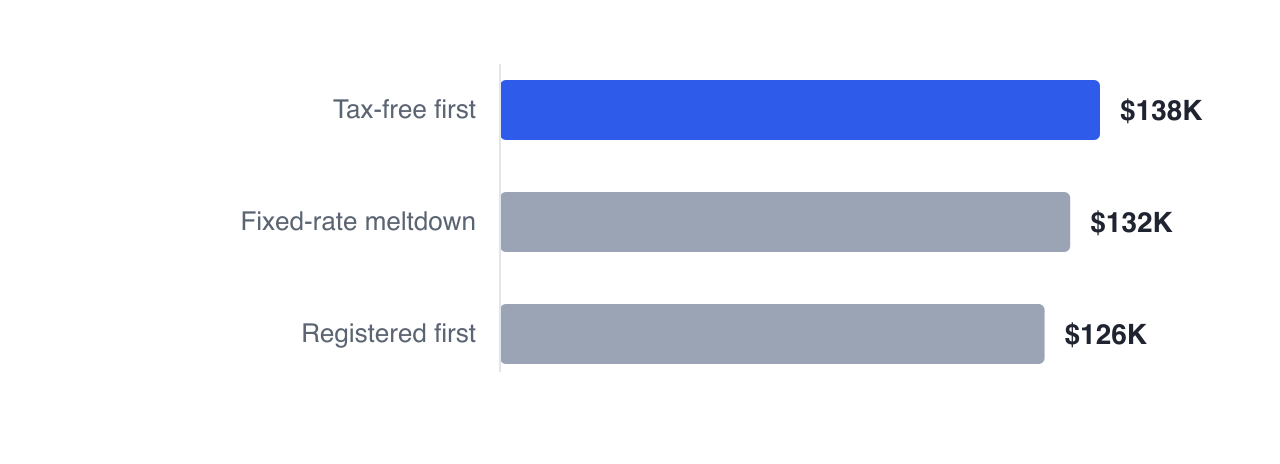
Drawing tax-free accounts first sounds like the cautious choice, and for the TFSA itself it is. But it also means the RRSP sits untouched and compounding for longer — so by 72, when the mandatory RRIF minimum kicks in, it is a percentage of a BIGGER balance than the registered-first order left behind. The registered-first order, having already been drawing that account down for a decade, faces a smaller forced withdrawal at 72 despite drawing it "first". Neither order crosses the recovery line for Dan and Marie — but a household with a larger RRSP, or closer to the threshold to start with, could find the TFSA-first order is the one that trips it, not the one that avoids it.
What reduces it
Anything that lowers net income in the years OAS is being paid: TFSA withdrawals, which are invisible to the test; drawing a registered balance down before OAS starts, so the mandatory withdrawals later are smaller; splitting eligible pension income with a spouse; and spreading a large one-off realisation across more than one tax year where that is possible.
One timing detail catches people. The recovery is assessed on the prior year’s income and then collected by reducing the following year’s monthly payments. A single large income year therefore shows up as reduced OAS a year later, which can be confusing if the income that caused it has already passed and the income in the year of reduction is back to normal.
The projection reports gross and net OAS separately every year, so any recovery appears as the gap between them — and clicking the year shows exactly which income caused it.
Next: the clawback that is three times harsher, and hits people with far less money.
GlidePathEngine is an educational planning tool — not financial, investment, tax, or legal advice.