OAS: residency, the full benefit, and the clawback
CPP is something you paid for. OAS is something you qualify for by having lived in Canada, funded out of general revenue. That difference explains both its strangest feature and its most expensive one.
Qualifying: a residency test, not a work test
OAS becomes available at 65 and is based on how long you have lived in Canada after 18. Roughly 40 years of residency earns the full benefit; fewer years earns a proportional fraction of it, in fortieths. Someone who immigrated at 45 and retires at 65 has twenty qualifying years and receives about half.
The full amount is roughly $8,999 a year in today’s dollars. Like CPP it is indexed and paid for life, so in a real-dollar plan it appears as a flat line rather than a rising one.
Deferring OAS
OAS can be deferred to 70, which increases it permanently by 36.0%. Unlike CPP there is no option to start it early — 65 is the floor. The deferral decision interacts with the clawback below, since a larger benefit is also a larger thing to lose.
The clawback (officially, the recovery tax)
The threshold is tested on each individual, not on the household, which is one of the reasons pension income splitting later in this series matters so much to couples. Two people each below the threshold keep their full benefits; one person above it and one well below can lose a chunk of one.
Priya, comfortably under — for now
Priya — 54, Ontario, single. $118,000 salary, $410,000 in her RRSP and $88,000 in her TFSA, planning to retire at 63.
Priya’s plan pays her the full $8,999 from 65, and her retirement income stays below the recovery threshold, so none of it is taken back. That is not a fixed property of her situation — it is a consequence of how much she withdraws each year, which is a decision rather than a fact.
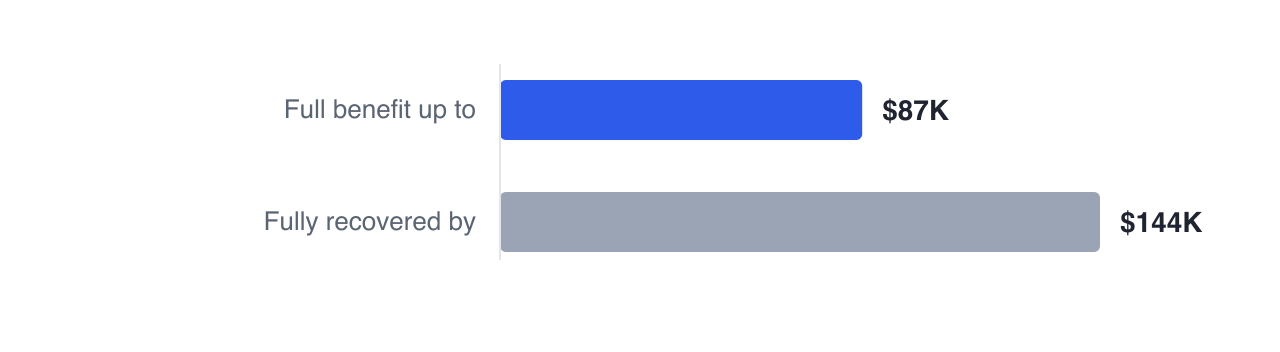
The reason this appears in a Foundations-adjacent episode rather than an advanced one is that the withdrawal decisions which push income over the line are made decades earlier, when the registered balance that eventually forces them out is still being built.
What OAS does not have
There is no OAS survivor benefit. When one spouse dies, their OAS simply stops — a detail that changes a surviving spouse’s income more than most people expect, and one the survivor episode returns to. CPP does have a survivor pension, with its own rules.
The projection reports gross and net OAS separately for every year, so any recovery shows up as a gap between the two — and the year drill-down shows what pushed income over the line.
Next: the FHSA — the only account that is deductible going in and tax-free coming out.
GlidePathEngine is an educational planning tool — not financial, investment, tax, or legal advice.