The small business deduction and the passive income grind
Here is a rule that surprises owner-managers every year: the return on your corporate investment portfolio can raise the tax rate on your operating business. The two look unrelated. They are connected by a five-to-one lever.
The small business deduction
The first $500,000 of active business income is taxed at the small business rate — roughly 12.2% — rather than the general rate of about 26.5%. That difference is the whole deferral advantage from episode 59, and it applies to a limit rather than to everything.
Five to one is a startling ratio. It means a hundred-thousand-dollar band of investment income can erase a half-million-dollar deduction — and it applies with no regard to how large or small the operating business is.
Two details that determine the outcome
The grind is calculated on the prior year’s investment income. So a strong investment year today raises the tax on the business next year — a lag that makes the connection easy to miss when the bill arrives.
And what counts is the income, not the portfolio size. Interest counts in full. Realised capital gains count at the inclusion rate, so only half of a realised gain lands in the calculation — and an unrealised gain counts for nothing at all until it is realised.
That second point is the actionable one. A corporate portfolio generating interest hits the threshold far faster than one generating deferred capital gains of the same total return. Composition matters here in a way it does not in a personal account.
Sam’s portfolio against Sam’s business
Sam — 41, British Columbia, self-employed through a corporation. No employer pension, no home yet, and a company that pays them both salary and dividends.
Sam’s corporation earns $210,000 of active business income — comfortably inside the $500,000 limit — and holds $180,000 of investments alongside it. Those two facts are not independent.
As the portfolio grows, the income it throws off approaches the $50,000 threshold. Every dollar past it removes five dollars of small business limit — which is to say, the reward for a successful deferral strategy is a higher tax rate on the business that funded it.
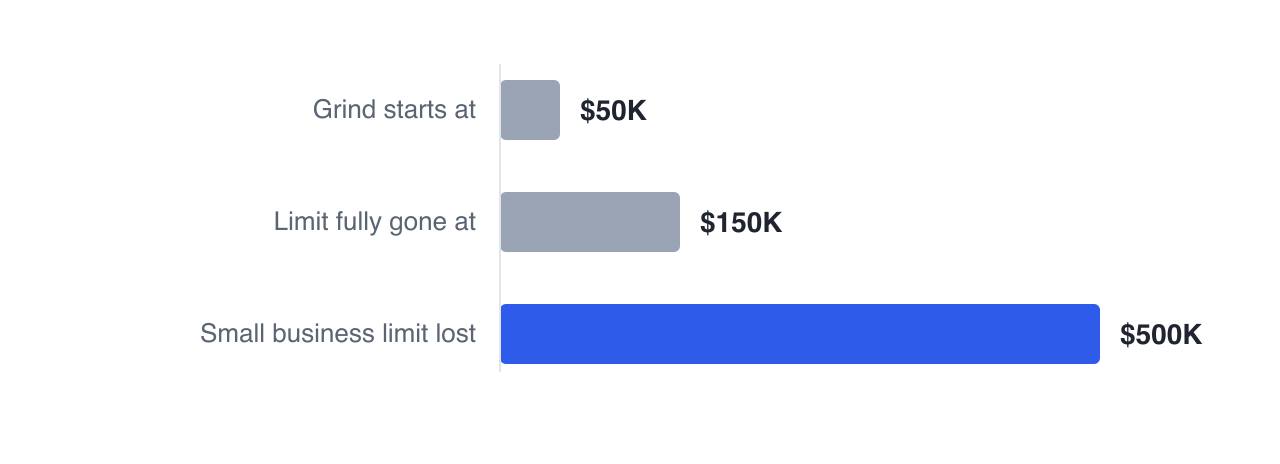
The projection applies the grind against the prior year’s investment income, so the interaction shows up in the corporate tax figures rather than having to be remembered. Which matters, because the effect arrives slowly and then all at once.
What can be done about it
- Hold assets that generate deferred capital gains rather than interest, so less income is realised each year for the same total return.
- Pay out enough as salary or dividends that the corporate portfolio grows more slowly — accepting personal tax now to keep the business rate.
- Use individual pension plans or permanent insurance, both of which sit outside the calculation, and both of which bring their own complexity and cost.
- Accept the general rate. Above a certain portfolio size the deduction is simply gone, and planning around a limit you have permanently exceeded wastes effort.
The corporate section takes the portfolio and its income character, and the projection applies the grind year by year — so the interaction between the portfolio and the business rate is visible rather than annual news.
Next: RDTOH, CDA and GRIP — the three corporate pools, in plain language.
GlidePathEngine is an educational planning tool — not financial, investment, tax, or legal advice.