Pension income splitting (T1032)
There is a form that lets a couple move income from the higher earner’s tax return to the lower earner’s without moving a single dollar between accounts. It is filed with the annual return, it takes minutes, and its value compounds every year for the rest of both lives.
What it does
The gain comes from progressivity. Income taxed at a high marginal rate on one return is instead taxed at a lower rate on the other. Two people each with moderate incomes pay less combined tax than one person with a large income and one with almost none — and the election lets a couple choose which of those two situations they are in.
What counts as eligible pension income
This is where most of the confusion lives, because eligibility depends on both the source and your age.
- A defined benefit pension is eligible at any age, which is why a pension holder can split from the day it starts.
- RRIF and life annuity income becomes eligible at 65, not at 71. Converting some RRSP to RRIF at 65 is what makes that income splittable years before the conversion deadline forces anything.
- CPP and OAS are not eligible under this election. CPP has its own separate sharing arrangement with different rules; OAS has nothing.
- RRSP withdrawals that have not been converted to a RRIF are not eligible either — the account type matters, not just the money.
The 65 threshold is the actionable detail. A couple in their late sixties with large RRSPs and no pension often assumes splitting is unavailable to them, when a partial conversion would make it available immediately.
Three effects, not one
Moving income across returns does more than change bracket exposure. It also moves each spouse relative to the OAS recovery threshold of about $95,323, and it can create eligible pension income on the receiving spouse’s return, unlocking their own pension income credit of roughly $2,000. Age-related and spousal credits shift too.
Because the effects interact, the split that minimises income tax is not always the split that minimises the total household cost including clawbacks. That is an optimisation problem rather than a rule, and it is why the projection searches for the best transfer each year rather than defaulting to half.
One year, and thirty
Dan & Marie — 58 and 56, Alberta. Dan retires at 62 with a defined-benefit pension; Marie retires at 60. Their RRSPs are very different sizes, which matters later.
In Dan and Marie’s age-75 year the household would pay $27,486 of income tax with no election. With the optimal split applied it pays $26,295 — a saving of $1,191 for filing a form.
Repeat that across every year both are alive and eligible, and the plan saves $37,372 in total. No investment decision, no additional saving, no change in spending — the same income, reported differently.
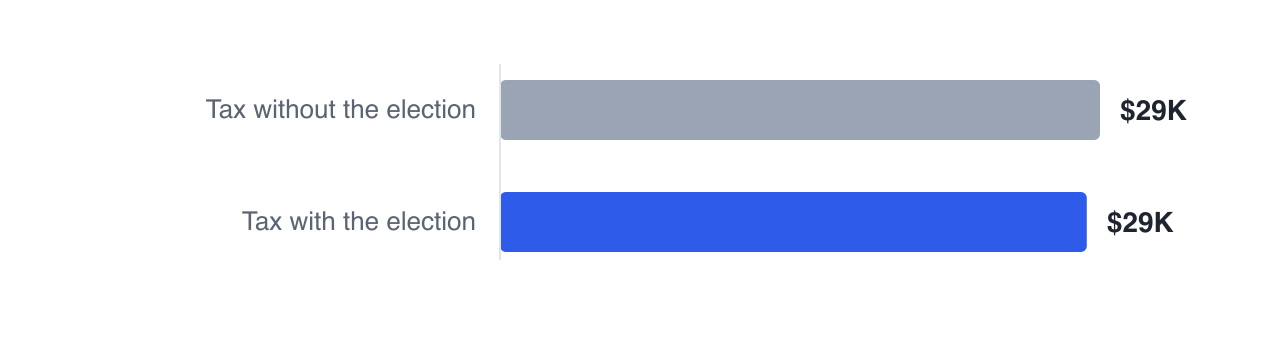
Their saving is moderate because their incomes are not wildly different to begin with. A couple with one large pension and one spouse with almost no income of their own has far more to gain, since the gap between the two marginal rates is the thing being harvested.
When it stops
The election requires two living spouses. In the year one dies the household moves to a single return, and the survivor absorbs income that was previously spread across two sets of brackets and two clawback thresholds. That transition is often the largest tax change in a retirement, and it is the subject of a later episode.
The projection optimises and applies the split every year, and reports the tax with and without it — so the value shows up as a reconciled before-and-after rather than an estimate.
Next: the spousal RRSP — still useful in a world where income can already be split.
GlidePathEngine is an educational planning tool — not financial, investment, tax, or legal advice.