Per-account returns and glide paths
Most projections ask for one expected return and apply it to everything you own. That is a reasonable simplification right up to the point where your accounts stop being interchangeable — which, for most households, is well before retirement.
Why accounts diverge
Accounts differ in when they will be spent. A TFSA that a plan preserves to the end has a longer horizon than a non-registered account funding the first five years of retirement. Money with a longer horizon can generally carry more variance, because there is more time to recover from a bad stretch.
They also differ in tax treatment, which is the next episode’s subject, and sometimes in what they are allowed to hold. A group plan may offer a limited fund menu; a locked-in account may have been left in whatever the pension transferred it as.
Modelling it without inventing precision
The honest way to represent this in a plan is a schedule per account: a base rate, plus optional steps that change the rate from a given age onward. A single step at retirement captures most of a real glide path; several steps capture a gradual one. Neither pretends to know which year a market will turn.
The alternative — one rate everywhere — is not wrong so much as silent. It cannot show the effect of holding the account you will spend last more aggressively than the one you will spend first, which is a real decision many households have already made without writing it down.
Three accounts, three horizons
Priya — 54, Ontario, single. $118,000 salary, $410,000 in her RRSP and $88,000 in her TFSA, planning to retire at 63.
At retirement Priya holds $132,279 in her TFSA and $79,394 in non-registered savings, with the registered balance reaching $791,637 by 72. Her plan uses the default TFSA-first order, so those three accounts are spent at very different times: the TFSA in her first few retirement years, the non-registered savings next, and the registered money across every year after that — it is still paying her at 90.
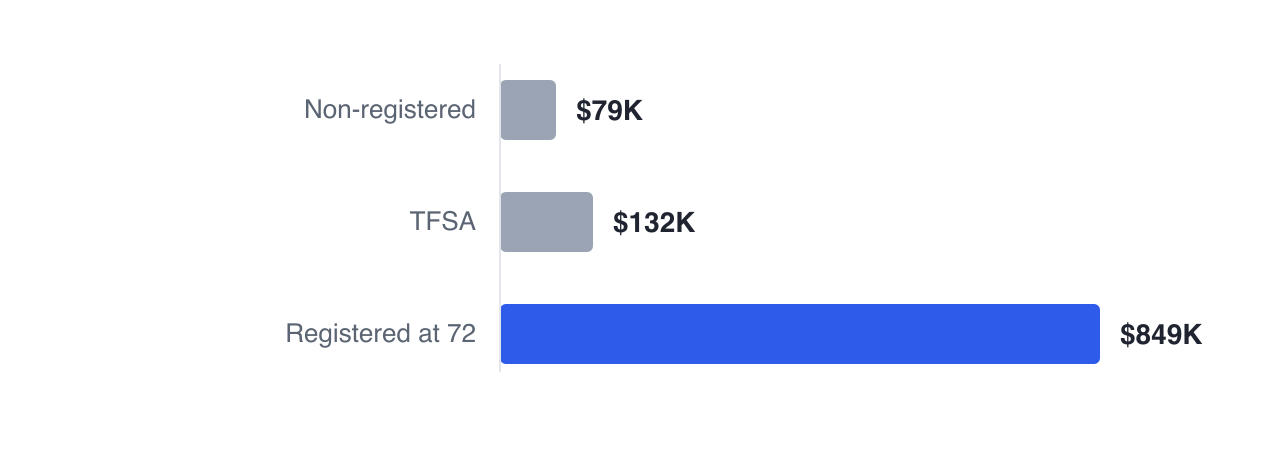
A single blended rate across all three implies she invests the account she spends at 63 exactly like the one still paying her at 90. She might — plenty of people do — but it should be a choice rather than an artefact of how the plan was set up.
The one detail worth knowing
When per-account rates are in play, the plan still needs a single anchor rate — for simulations, and for any account without its own schedule. The projection derives it as the balance-weighted blend of your schedules, which means the summary number you see stays consistent with the detail underneath it, and simulations shock every account around its own rate rather than around a single average.
That is a modelling detail with a practical consequence: turning per-account rates on and setting them all equal to your old single rate reproduces your old plan exactly. The feature adds detail; it does not quietly change your answer.
Turn on custom returns in the assumptions and each account gets its own schedule, with optional age-based steps for a glide path — seeded from your current single rate so nothing changes until you change it.
Next: capital gains — inclusion rate, cost base, and the disposition nobody sees coming.
GlidePathEngine is an educational planning tool — not financial, investment, tax, or legal advice.