Corporate investment income: RDTOH, CDA and GRIP
Investment income inside a corporation is taxed at over fifty percent, which sounds like a penalty and is actually a deposit. Understanding the three pools that track it is what turns corporate investing from mysterious into merely complicated.
Why the rate is so high
Investment income inside a corporation is taxed at roughly 50.2% — deliberately close to the top personal marginal rate. The design goal is that there should be no advantage to earning investment income through a company rather than personally.
RDTOH: the refundable deposit
Refundable dividend tax on hand is the running balance of refundable tax the corporation has paid. When a taxable dividend is paid to shareholders, a portion of the RDTOH balance is refunded to the corporation.
It is split into two pools. Eligible RDTOH is fed largely by Part IV tax — a fully refundable 38.3% charged on dividends the corporation receives from other Canadian companies — and can be recovered by paying eligible dividends. Non-eligible RDTOH is fed by the refundable portion of tax on interest and realised gains, and requires paying non-eligible dividends to recover.
The two-pool split exists to stop a corporation converting non-eligible income into lower-taxed eligible dividends. It also means the *kind* of dividend paid determines which refund is triggered.
CDA: the tax-free pool
The capital dividend account is the best of the three. Since only 50% of a capital gain is taxable, the other half has already borne no tax — and that untaxed half is credited to the CDA. Amounts in the CDA can be paid to shareholders entirely tax-free.
Life insurance proceeds received by the corporation also credit the CDA, less the policy’s cost base, which is the mechanism behind most corporate insurance planning. The CDA gets its own episode next, because it is the one pool with a genuinely free outcome attached.
GRIP: the eligible-dividend capacity
General rate income pool tracks how much income the corporation has taxed at the general rate rather than the small business rate. Only that amount can be paid out as eligible dividends, which carry the larger 38% gross-up and the larger credit.
The logic is integration again: an eligible dividend gets a bigger personal credit because more corporate tax was already paid on it. GRIP is simply the ledger proving that was true.
What the pools cost and return
Sam — 41, British Columbia, self-employed through a corporation. No employer pension, no home yet, and a company that pays them both salary and dividends.
Sam’s corporation pays $1,628,802 of corporate tax across the plan — active business tax plus the investment-income tax on the portfolio. A large share of that investment portion is refundable and comes back as dividends are paid.
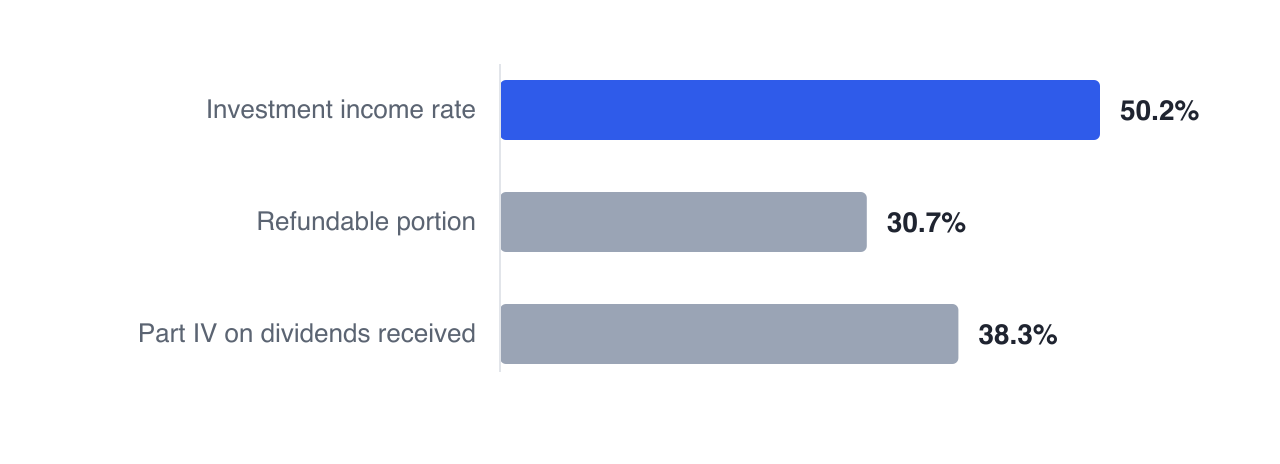
The gap between the first two bars is the genuinely permanent corporate cost on investment income. It is small, which is the integration design working — and it is the reason corporate investing is roughly neutral rather than advantageous once the money is already inside.
Why any of this matters to a retirement plan
The pools determine what a retired owner-manager can actually draw, and how it will be taxed. A corporation with a healthy CDA can pay a tax-free amount; one with a large RDTOH balance has an incentive to pay dividends and recover it. Neither is visible from the balance alone, and both change what the plan can support.
The projection tracks the pools year by year as the corporation earns, invests and distributes — so what the company can pay you in retirement is computed rather than assumed.
Next: the capital dividend account — getting money out of a corporation tax-free.
GlidePathEngine is an educational planning tool — not financial, investment, tax, or legal advice.