Rebalancing and drift
Set an asset mix, do nothing for ten years, and you no longer have that mix. Whatever grew fastest is now the largest holding — which means a portfolio left alone drifts steadily toward whatever has recently done best, and therefore toward more risk.
Why drift happens
Assets grow at different rates, so their shares of the portfolio change. Over a long stretch of strong equity returns, an equity-and-bond portfolio becomes a substantially more equity-heavy one without a single transaction.
That timing is what makes rebalancing feel wrong. It requires selling the thing that has done well to buy the thing that has not, which is uncomfortable precisely when it is doing the most good.
What rebalancing is and is not
It is risk control: restoring the mix you chose. Whether it also improves returns is genuinely debated and depends on the period examined. Treating it as a return strategy invites disappointment; treating it as maintaining the risk level you decided on is defensible in any market.
Two common approaches: on a calendar — annually, at a date you pick in advance — or on a threshold, when a holding drifts more than a set amount from target. Both work; picking one in advance is what stops the decision being made by mood.
Where you do it decides what it costs
Inside a registered or tax-free account, rebalancing is free of tax consequence. In a taxable account, selling to rebalance realises gains, and 50% of them is taxable — which can make restoring a mix genuinely expensive.
Two ways around it. Rebalance with new contributions, directing them at whatever is underweight, which costs nothing at all. And do the selling inside the sheltered accounts while leaving the taxable one alone — which requires thinking about the portfolio as a whole rather than account by account.
Three accounts, one portfolio
Priya — 54, Ontario, single. $118,000 salary, $410,000 in her RRSP and $88,000 in her TFSA, planning to retire at 63.
Priya holds $79,394 taxable, $132,279 tax-free and a registered balance reaching $791,637. Rebalancing inside the two sheltered accounts costs nothing; doing it in the taxable one realises gains.
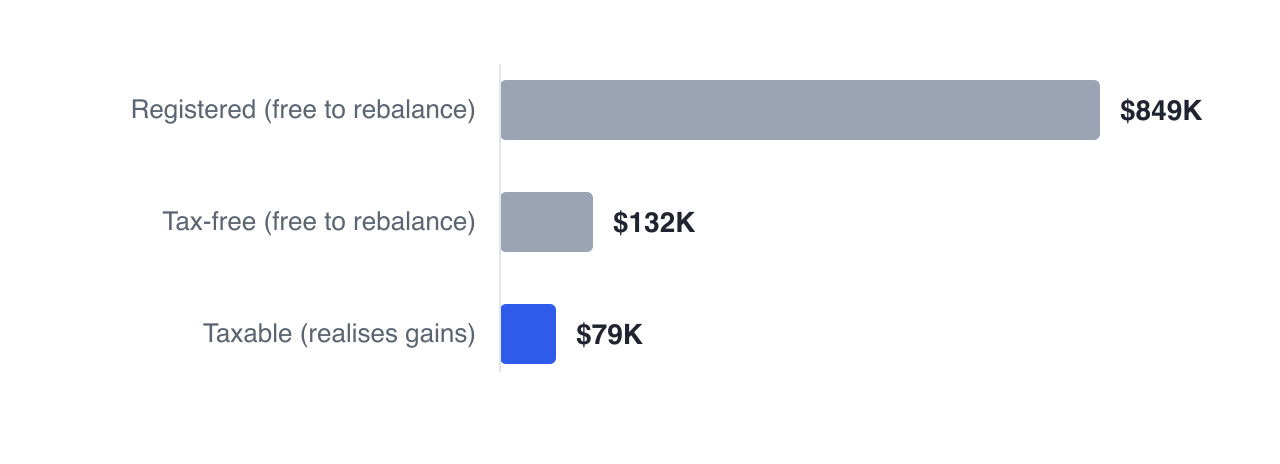
Because the sheltered accounts are much the larger share, almost any rebalancing she needs can be done there. That is the general case, and it is what makes the tax objection to rebalancing weaker than it first appears.
How it appears in a plan
A projection assumes a return per account rather than a portfolio of holdings, so it does not model drift directly. What it does model is the consequence: the return each account earns — around 2.8% real on the shared assumptions used throughout this series — and an age-based schedule if you want the rate to fall as a horizon shortens.
That schedule is the plan-level expression of a glide path from episode 34. Rebalancing is how the real portfolio keeps up with what the plan assumed — without it, the actual mix drifts away from the return assumption the whole projection rests on.
Per-account return schedules let each account carry its own rate with optional age-based steps, so the assumption in the plan reflects the mix you are actually maintaining.
Next: the annual review — a thirty-minute checklist.
GlidePathEngine is an educational planning tool — not financial, investment, tax, or legal advice.