Rental property inside a retirement plan
A rental property is genuinely a retirement asset, and it behaves nothing like a portfolio: its income is taxed at the least favourable rate available, and the gain waiting inside it is not exempt the way a principal residence’s is.
The income side
Net rental income — rent less expenses — is taxed as ordinary income at your full marginal rate. Not the capital gains rate, not the dividend rate. It is the same treatment as interest, which is the most heavily taxed form of investment income there is.
Deductible expenses include mortgage interest but not principal, plus property tax, insurance, maintenance and management. Capital improvements are not deductible — they add to the cost base instead, which matters at the other end.
The capital gain waiting at the end
A rental is not a principal residence, so its gain is not exempt. On sale or at death the accumulated gain is realised, 50% of it is taxable, and after decades of appreciation that can be a very large single-year addition to income.
There is a second, less-known component: recapture of capital cost allowance. If depreciation was claimed against rental income over the years, some of it is added back to income on sale — as ordinary income, not as a capital gain. A deduction taken at a modest rate can come back at a high one.
Because the whole realisation lands in one tax year, it interacts with everything: the bracket, the OAS recovery, and any income-tested benefit. Selling in a low-income year rather than a high-income one is often worth more than the price difference from waiting.
The two rates that apply
Priya — 54, Ontario, single. $118,000 salary, $410,000 in her RRSP and $88,000 in her TFSA, planning to retire at 63.
Rental income would be taxed at Priya’s full marginal rate — 37.2% while she is working, 19.1% at 70. The eventual gain would be taxed at 50% of the rate that applies in the year of sale.
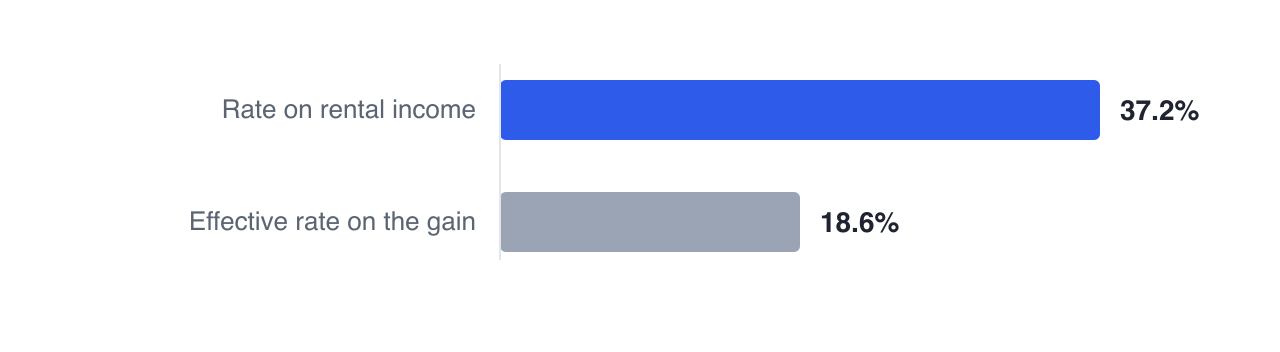
That asymmetry is the tax shape of a rental: the ongoing income is expensive and the appreciation is comparatively cheap. It is the reverse of most portfolio assets, and it argues for holding a rental as a growth asset rather than an income one where that is a choice.
The concentration question
A rental is often a very large fraction of a household’s net worth — a single asset, in a single city, in a single sector, that cannot be partially sold. A portfolio holding that concentrated in one position would be considered a risk; a rental usually is not, because it does not look like a portfolio.
It also requires active management well into a retirement, which is a real consideration in your eighties and rarely modelled as a cost.
The real estate section carries a rental with its income, expenses, mortgage and an optional sale year — so the taxable income during ownership and the gain at the end both appear in the projection.
Next: downsizing — how much of the equity actually reaches the portfolio.
GlidePathEngine is an educational planning tool — not financial, investment, tax, or legal advice.