RESP and the CESG: the 20% left on the table
The employer match from episode 18 was the only guaranteed return in this series. This is the second one, and it is available to anyone with a child — a twenty percent match from the federal government, subject to caps that quietly set your contribution schedule.
The grant, in numbers
Those numbers interact in a way worth reading carefully. Contributing $2,500 a year collects the full annual grant; 14 such years, plus a smaller top-up in the year after, exhaust the lifetime grant. Contributing more than the eligible amount in a year does not attract more grant — the excess simply grows without a match.
There is also an additional grant for lower-income families, at a higher match rate on the first slice of contributions, plus a bond that requires no contribution at all. Both are worth checking against the household income thresholds, since they are claimed the same way.
Carry-forward, and the pace it implies
Unused grant room carries forward, but only one extra year’s worth can be claimed in any single year — so the practical maximum is $1,000 of grant per year, on $5,000 of contribution.
That rule is what makes a large single contribution inefficient. Depositing the full lifetime limit for a newborn maximises tax-sheltered growth and forfeits most of the grant, because the grant can only be collected at a fixed pace. Catching up later is possible, at a rate of one extra year annually, and the grant stops at a maximum age regardless of unused room.
The pace the caps dictate
Sam — 41, British Columbia, self-employed through a corporation. No employer pension, no home yet, and a company that pays them both salary and dividends.
Contributing $2,500 a year collects $500 of grant, every year, for 14 years; a smaller contribution in the year after collects the rest. The whole $7,200 is claimed on $36,000 of contributions in total — well under the $50,000 lifetime limit — the grant runs out long before the room does.
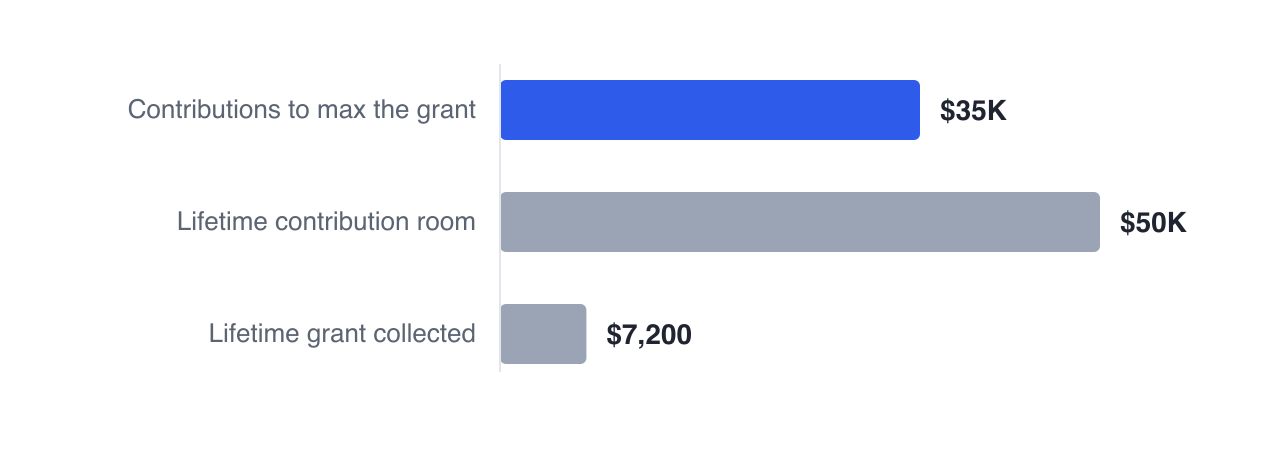
For a self-employed parent in Sam’s position, the RESP would compete with the corporate account, the FHSA and the RRSP for the same dollars. The grant is the strongest argument any of them has — a twenty percent immediate return, with no market risk attached.
What happens if the child does not go
Contributions come back to the subscriber tax-free — they were after-tax dollars going in. The grant is returned to the government. The accumulated growth can be transferred to an RRSP if there is room, or withdrawn with tax plus an additional penalty charge. A family plan for multiple children softens this considerably, since another beneficiary can use the same account.
One structural choice worth making early: an individual plan names one beneficiary, while a family plan can name several related children and move money between them. A family plan is materially more flexible if one child studies longer than another or does not go at all, and the flexibility costs nothing to set up at the start — while converting later is more awkward than choosing correctly the first time.
The RESP section takes a balance, an annual contribution and each child’s age, and the projection applies the grant against its annual and lifetime caps — so the schedule the caps imply is visible rather than assumed.
Next: taking the money out — EAP versus PSE, and who pays the tax.
GlidePathEngine is an educational planning tool — not financial, investment, tax, or legal advice.