RESP withdrawals: EAP versus PSE
After eighteen years of contributing, the withdrawal turns out to have a structure nobody mentioned: the account contains two distinct pots, taxed to two different people, and the order you take them in is a real decision.
Two pots in one account
Taxable in the student’s hands is the crucial phrase. A student with tuition credits and little other income typically has a marginal rate at or near zero, so an EAP is often taxed at nothing at all. The same amount taxed to a working parent would not be.
Why the order matters
Because the EAP is the taxable pot and the student is the low-rate taxpayer, drawing EAP first — while the student is enrolled and has credits to absorb it — usually costs the least tax. Contributions have no deadline and no tax consequence, so they can wait.
Doing it the other way around is the common mistake. Withdrawing contributions first feels natural — it is "your" money — and it can leave a large taxable EAP balance at the end of the studies, when enrolment ends and the credits stop.
- There is a limit on EAP in the first several weeks of enrolment; after that, larger amounts can be taken.
- EAP requires proof of enrolment in a qualifying program. Once enrolment ends, that route closes and remaining growth becomes much more expensive to access.
- The account has a maximum lifetime, after which it must be wound up regardless of what remains in it.
What is in the two pots
Sam — 41, British Columbia, self-employed through a corporation. No employer pension, no home yet, and a company that pays them both salary and dividends.
A fully funded plan can hold up to $50,000 of contributions and $7,200 of grant per child, plus every dollar of growth on both. The contributions come out tax-free; the grant and all the growth are the taxable pot.
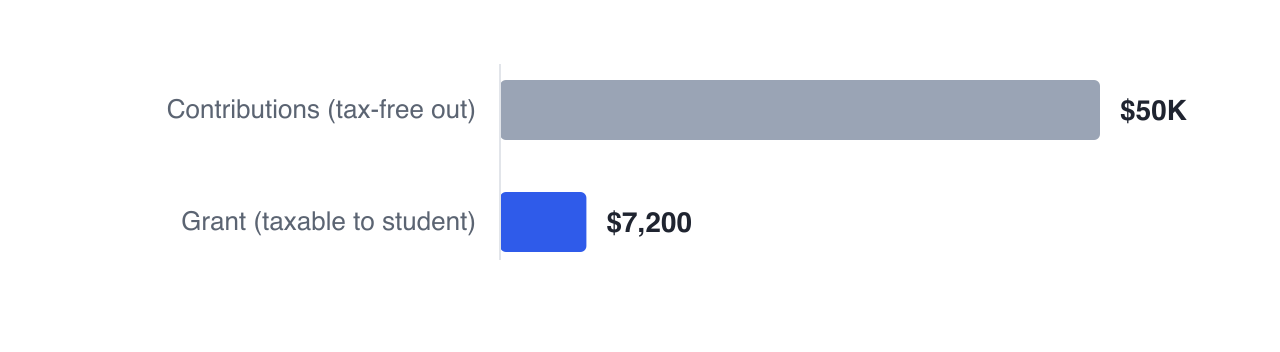
Growth sits on top of both bars and belongs entirely to the taxable side, which is why the taxable pot is usually far larger than the grant figure alone suggests. After eighteen years of compounding it can rival the contributions.
A practical sequencing note
Because an EAP is taxable to the student, it interacts with their own tax situation — a co-op placement or a well-paid summer can push them into a bracket where the EAP is no longer free. Spreading EAPs across the study years, rather than concentrating them, keeps each year’s amount inside the credits available that year.
None of this is complicated once the two pots are visible. Nearly all of the tax paid on RESP withdrawals comes from not knowing there were two.
With each child’s age entered, the projection shows the RESP balance and its withdrawals across the study years, so the size of the taxable pot at that point is visible while there is still time to plan the sequence.
Next: modelling a large one-time purchase without quietly wrecking the plan.
GlidePathEngine is an educational planning tool — not financial, investment, tax, or legal advice.