The retirement readiness gauge, explained
A readiness gauge is only as useful as the question it asks. The obvious question — "is my net worth positive at the end?" — produces a number that says almost nothing, and it took getting that wrong to see why.
What it measures
That framing has a useful property: it is about the years, not the endpoint. A plan can end with money left and still have three uncomfortable years in the middle, and a year-by-year measure catches that where an endpoint measure does not. It is also deliberately strict about it: a shortfall at 75 costs every year after 75 as well, because a plan that has already failed once is not funded in the years that follow just because the arithmetic recovers.
Why it ignores your house
The obvious alternative is to check whether net worth stays positive. That measure produces confident-looking answers for households that cannot pay their bills, because net worth includes a principal residence — and a house does not pay for groceries.
A retiree with a large home and a small portfolio can show healthy net worth for thirty years while running out of spendable income in year eight. Home equity becomes available only by selling, borrowing against it, or dying — none of which a projection should quietly assume. So readiness looks at income, and property appears elsewhere as the asset it is.
The other design decisions
- It measures income before tax — every dollar the plan pays out that year, taxable or not, including TFSA and non-registered withdrawals — consistent with how the retirement income target is defined (a percentage of pre-retirement gross income, if that is the mode you chose). Mixing a pre-tax target with an after-tax measure would make almost every plan look broken.
- It allows a tolerance rather than demanding the target exactly: a year counts if its income reaches 90% of the target. A year that comes within that margin is not a failure in any meaningful sense.
- It is a deterministic measure, computed on the single projection. The probability question — how often does this work across many return sequences — is what the simulation answers, and the two are complementary rather than redundant.
Reading Priya’s plan on two different measures
Priya — 54, Ontario, single. $118,000 salary, $410,000 in her RRSP and $88,000 in her TFSA, planning to retire at 63.
Priya targets $58,000 a year from 63. Her plan peaks at $917,791 of net worth and ends at $399,597 of net estate, which on a balance measure looks unambiguously comfortable. Readiness ignores both numbers and asks a different question: in her age-70 year, the plan pays her $57,999 against a $58,000 target. Only $35,267 of that is taxable income; the rest is non-registered money she draws, which is spendable whether or not it is taxed — so the gauge counts it.
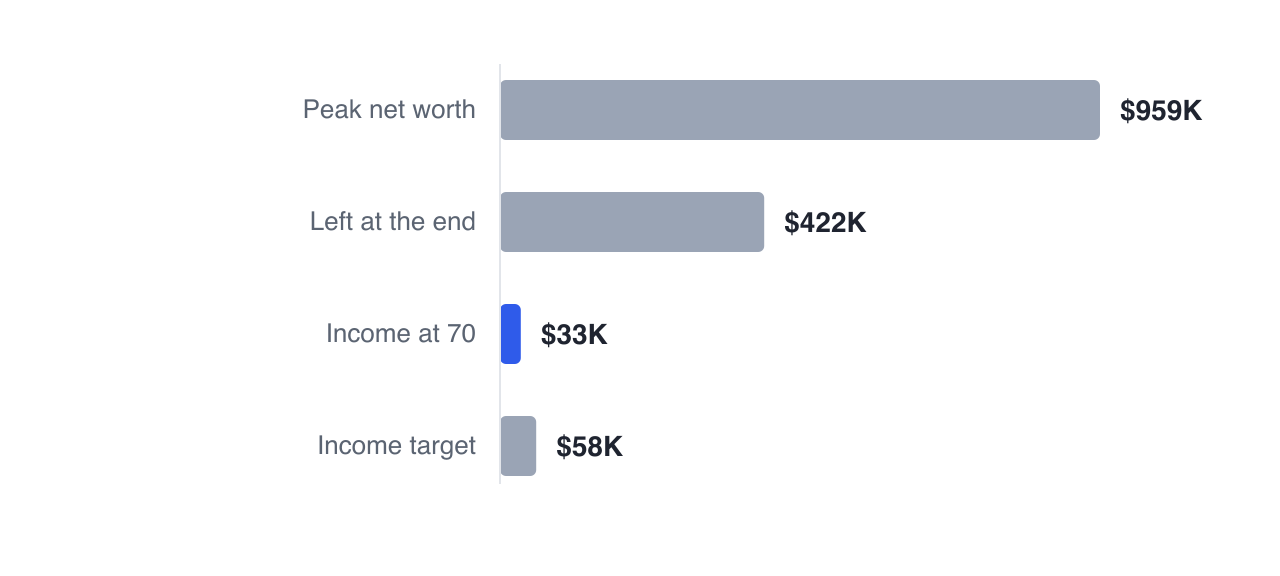
Every one of her retirement years clears that bar, so her gauge is full. The balances — $917,791 at the peak — are more than ten times any of these income figures, which is exactly why a balance measure and an income measure can disagree so completely about the same plan: a balance says what you own, and only income says whether this year is paid for.
What moves it
Retirement age moves it most, because it changes contributions and withdrawal years at the same time. Spending target moves it directly. Benefit timing and drawdown order move it through the tax bill. Investment return moves it slowly, and less than most people expect over the range of assumptions that are actually defensible.
The home view shows readiness alongside the net-worth chart, so you can see both measures at once — and disagree with them in an informed way rather than a hopeful one.
Next: what happens financially when one spouse dies.
GlidePathEngine is an educational planning tool — not financial, investment, tax, or legal advice.