Retiring earlier than you planned to
A meaningful share of Canadians retire earlier than they intended — health, a layoff, caring for someone. It is the single most valuable scenario to have modelled in advance, and the one people are least willing to look at.
Why it costs more than the salary
There are second-order effects too. Employer benefits and group insurance usually end. A defined benefit pension may be reduced for early commencement. Any bridge to CPP has to be longer, funded from a portfolio that received fewer contributions.
The compounding is what makes the numbers steeper than intuition suggests — which is why this is worth measuring rather than estimating.
Three years, and five
Priya — 54, Ontario, single. $118,000 salary, $410,000 in her RRSP and $88,000 in her TFSA, planning to retire at 63.
Priya plans to retire at 63 and her plan ends at $399,597. Retiring at 60 instead — three years early, everything else unchanged — ends at $37,505. At 58, it is $1,183.
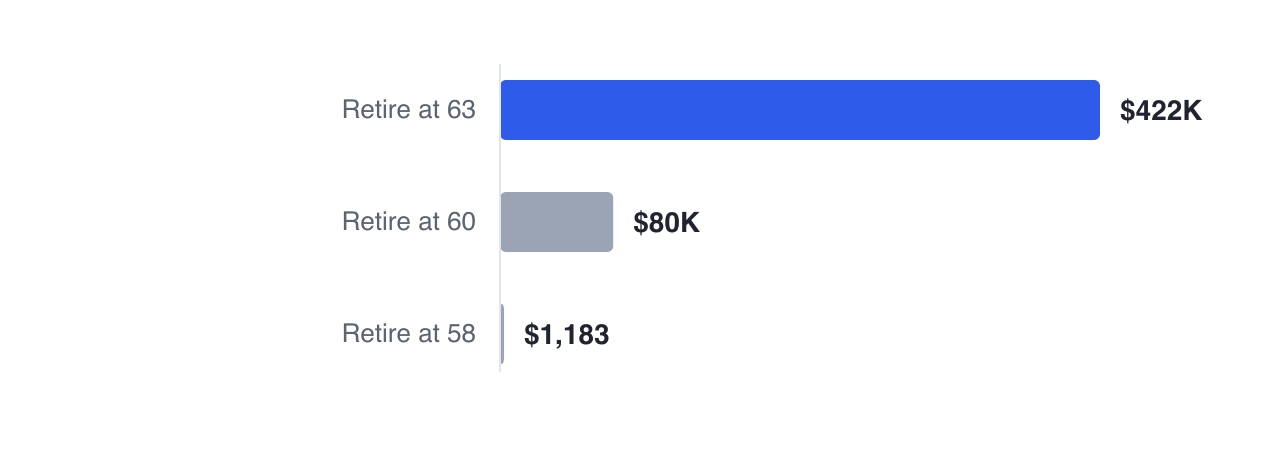
Look at the shape rather than the values. Three years costs most of what was left over; five years costs essentially all of it. The relationship between years and cost accelerates, so a plan can tolerate a small shortfall and be broken by a moderate one.
Her simulated success rate tells the same story in probability terms: 75.7% on plan against 42.8% retiring at 60. The spending is still mostly funded — but the margin she was relying on has gone.
What a household can actually do
- Know the cliff age — the earliest retirement the plan survives. It is one number, and it converts an unbounded worry into a boundary.
- Understand that partial work changes the arithmetic more than it looks. Even modest income during the early years removes withdrawals from the years sequence risk hits hardest.
- Keep flexible spending identified, so a reduction is a decision you have already thought about rather than an emergency.
- Remember that CPP is available from 60. Starting early is permanently smaller, and it may be the right answer in a plan that has lost its margin — the timing episode assumed a voluntary retirement.
That last point is worth sitting with. Several conclusions earlier in this series assume the retirement date was chosen. When it was not, the same levers can point the other way — which is a reason to re-run the plan rather than to apply remembered advice.
There is one bright spot worth knowing about. Retiring involuntarily often comes with a severance payment, and how that payment is received matters: some of it may be eligible for direct transfer to an RRSP without using contribution room, and spreading the remainder across two tax years is sometimes possible. The difference between handling that well and badly can be a year of retirement spending.
Move the retirement age down a year at a time and watch readiness and the success rate respond. The age where they fall away is the most useful single number in this scenario.
Next: how to ask "what if" so the answer means something.
GlidePathEngine is an educational planning tool — not financial, investment, tax, or legal advice.