The reverse mortgage question
A reverse mortgage is the most expensive way to access home equity and occasionally the only one available. Both halves of that sentence are true, which is why it deserves a clear explanation rather than either a sales pitch or a dismissal.
How it works
You borrow against your home, as a lump sum or in instalments, and make no payments while you live there. Interest accrues and compounds onto the balance. The loan is repaid when the home is sold, when you move out permanently, or from the estate.
The compounding is the part to sit with. A balance with no payments doubles over a period determined entirely by the rate. Taken at 70 and left for two decades, a modest advance can consume a large share of the home’s value — which is the whole cost of the product, arriving silently.
The genuine advantages
- The proceeds are borrowed money, not income, so they are not taxable and do not count toward the OAS recovery or the GIS reduction. For a low-income retiree that is a real and unusual property.
- You stay in the home, which is often the entire point and the reason downsizing was rejected.
- Canadian products generally carry a no-negative-equity guarantee: the repayment cannot exceed the home’s value, so the estate cannot be left owing more than the house is worth.
The tax-invisibility deserves emphasis. Every other way of raising cash — an RRSP withdrawal, selling an appreciated asset — creates income that a clawback can bite. This one does not.
The case where it is competitive
Ellen — 67, Nova Scotia, already retired on a modest income. Her CPP and OAS do most of the work and a small RRSP sits behind them.
Ellen lives on $32,000 a year including $8,180 of GIS, with a plan that ends at $1,341. Her registered balance is small, and every dollar she withdraws from it is taxed and reduces her benefit.
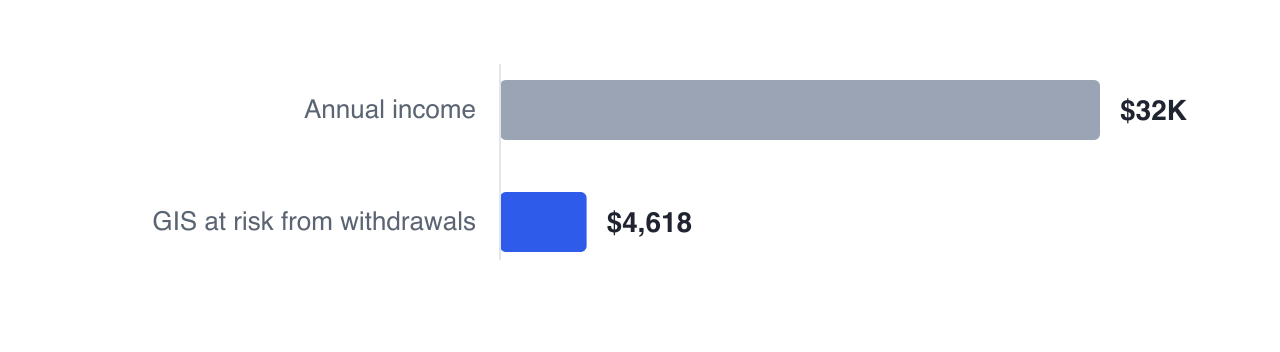
That is the honest case for the product: a house-rich, income-poor household facing the highest effective marginal rate in the country on any taxable withdrawal, who does not want to move. For that household an expensive loan can genuinely beat a taxed withdrawal — and for almost anyone else it does not.
What to compare it against
Downsizing, from the previous episode. A conventional home equity line of credit, if you still qualify — cheaper, and it requires payments. Selling and renting. Or drawing harder on the portfolio and accepting the tax. Each has a cost, and the reverse mortgage is worth considering only once the cheaper ones have been priced and rejected for a reason.
It is also worth having the conversation with family in advance, since the estate is what ultimately repays it. A decision made quietly in the eighties that substantially reduces an inheritance is better discussed than discovered.
The projection can show what a property sale, a larger withdrawal, or a debt at a given rate each do to your plan — which is the comparison this decision actually needs.
Next: health-care costs, and the gaps provincial coverage leaves.
GlidePathEngine is an educational planning tool — not financial, investment, tax, or legal advice.