RRIF minimums: the schedule and the surprise
Most people know a RRIF forces withdrawals. Fewer know that the required percentage rises every year for the rest of your life, and that it more than triples between the first year and the last one the table covers.
How the minimum is calculated
Each year the minimum is a prescribed percentage of the January 1st balance. The percentage comes from a published table keyed on your age, and it is not negotiable. Because it applies to the opening balance, a strong investment year raises the following year’s required withdrawal.
The interaction is what makes the schedule hard to intuit. In early retirement the balance is large and the percentage small; in late retirement the percentage is large and the balance smaller. The dollar amount forced out often peaks somewhere in the middle rather than at either end.
Why the required amount is a tax problem, not a cash problem
A mandatory withdrawal does not have to be spent. It has to be withdrawn and taxed. The after-tax remainder can go straight into a TFSA or a non-registered account. The money is not lost — it changes tax status, from deferred to taxed, on a schedule set by a table rather than by your circumstances.
That is why the schedule shows up in every other problem in this series. Forced taxable income is what pushes households into higher brackets, into the OAS recovery range, and out of income-tested benefits — in years when they are least likely to be adding to their savings.
What the table means in dollars for Priya
Priya — 54, Ontario, single. $118,000 salary, $410,000 in her RRSP and $88,000 in her TFSA, planning to retire at 63.
Priya carries roughly $791,637 of registered savings through her age-72 year. Applied to the balance she opened that year with, the schedule’s 5.4% required $43,909 of taxable income — considerably more than her plan actually needs her to spend. (The percentage is charged on the January 1st balance, not the year-end one, so the two figures here will not multiply together.)
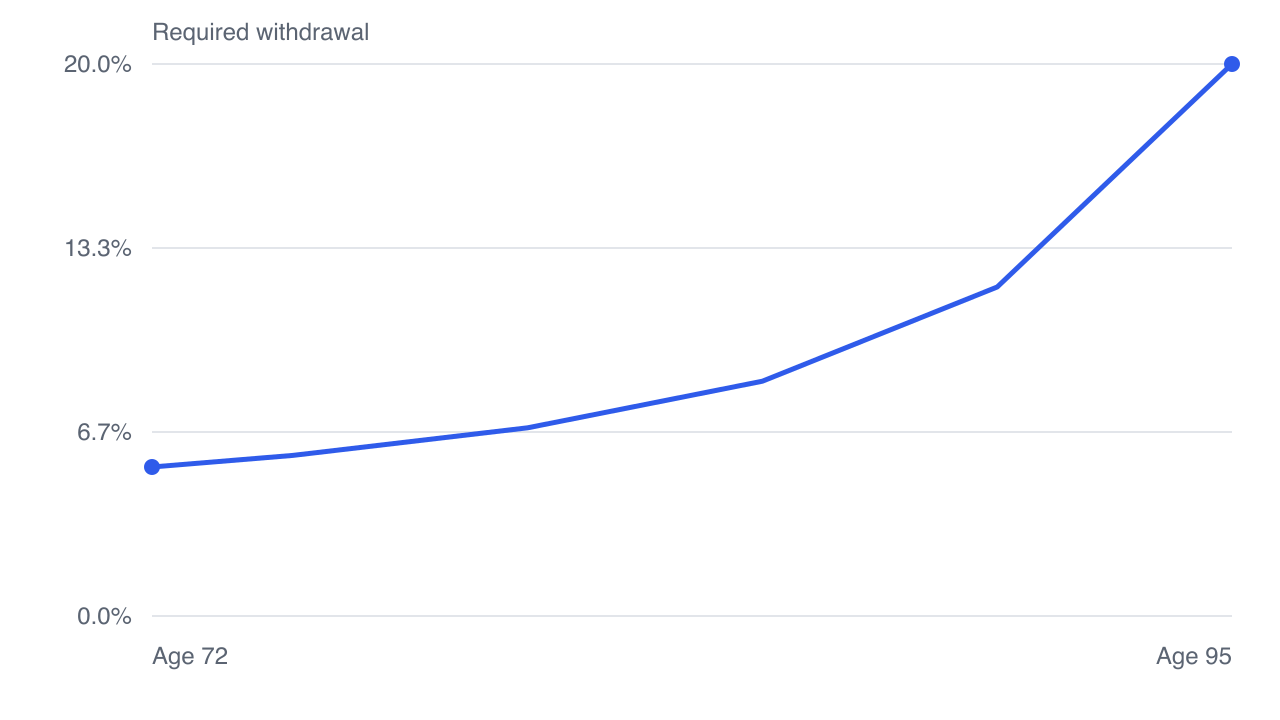
By 85 the percentage has risen by more than half, but her balance has been drawn down for thirteen years, so the required dollars are $41,993 — slightly less than at 72. The percentage and the balance are pulling in opposite directions, and neither one alone tells you what the year looks like.
What you can still influence
The percentages are fixed and the ages are fixed. The balance is not. Every dollar withdrawn before conversion is a dollar the schedule never gets to apply a percentage to. That is the entire logic behind the deliberate-drawdown strategies later in this series, and the reason they are usually decisions for your sixties rather than your seventies.
One mechanical detail that softens the tax slightly: withdrawals up to the minimum are not subject to withholding tax at source. That does not make them untaxed — the amount is fully taxable on the return — it just means the tax arrives at filing rather than at withdrawal, which can be an unwelcome surprise for someone who has never had to make instalment payments before.
The ledger has a column for the mandatory minimum in every year of your plan, next to the balance it is calculated from — so you can see the whole schedule applied to your own numbers.
Next: the drawdown order everyone defaults to, and why a default is not an answer.
GlidePathEngine is an educational planning tool — not financial, investment, tax, or legal advice.